


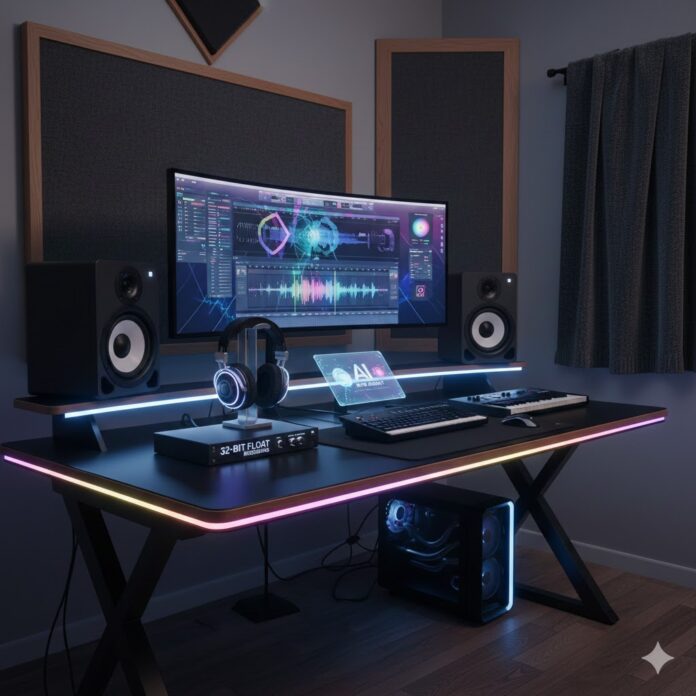
🚀 Your 2026 Home Studio: Tips, AI, and The Future of Pro Sound
The music and media production landscape is evolving faster than ever. By 2026, the lines between a home studio and a professional studio are virtually gone, thanks to powerful AI tools, next-gen audio interfaces, and accessible spatial audio formats.
Whether you’re a seasoned producer or setting up your first bedroom recording studio, this SEO-rich guide covers the essential tips and trends to ensure your setup is future-proof, efficient, and sounds absolutely professional.
🎧 The 2026 Essential Gear Checklist
The core of your studio remains the same, but the technology has jumped ahead. Investing smart now means fewer upgrades later.
-
1. The Computer (The Brain): Performance remains key. Focus on a fast CPU and ample RAM (16GB minimum, 32GB recommended) to handle complex virtual instruments and AI-driven plugins. Mac vs. PC is a preference—both run pro-level DAWs seamlessly.
-
2. Audio Interface (The Heart): Look for interfaces with:
-
Low-Latency USB-C/Thunderbolt: Essential for real-time tracking.
-
Clean Preamps: Aim for around 60 dB of clean gain if you plan to use low-output dynamic mics like the Shure SM7B.
-
32-bit Float Recording (Advanced): While 24-bit is excellent, 32-bit float offers a clipping safety net, making it highly valuable for unpredictable takes (Source 2.2).
-
-
3. Studio Monitors & Headphones: Get a reliable set of flat-response studio monitors (like Kali or ADAM Audio) and a great pair of reference headphones (like Sony MDR-M1ST). Crucially, invest in room correction software (e.g., Sonarworks SoundID) to tailor your listening to your specific room’s quirks (Source 4.1).
🤖 AI and Software: The 2026 Workflow Shift
AI is no longer a gimmick; it’s an integral part of the 2026 production workflow.
-
Digital Audio Workstations (DAWs): Choose a DAW that suits your style. Ableton Live 12 dominates for electronic/live production, Logic Pro X offers unmatched value for Mac users, and Reaper remains the versatile budget champion (Source 2.3).
-
Intelligent Plugins: The future is in smart plugins that manage repetitive tasks, freeing you to focus on creativity. Look for tools offering:
-
AI Mix Assistants: Automatically set initial levels, panning, and even suggest custom mix profiles.
-
Adaptive EQ: EQs that dynamically adjust in real-time to prevent mud or harshness.
-
Advanced Noise Removal: Tools like iZotope RX that non-destructively clean up vocal takes with near-perfect fidelity (Source 3.4).
-
-
Spatial Audio Production: Immersive audio (like Dolby Atmos) is becoming the standard. Ensure your software and interface support multi-channel monitoring or at least provide binaural monitoring tools for mixing in this format (Source 3.1).
🧱 The Silent Secret: Acoustic Treatment on a Budget
The single biggest factor in professional sound isn’t your microphone—it’s your room. Good acoustic treatment makes even budget gear sound great.
-
The Triangle Position: Start by placing your speakers and your head in an equilateral triangle (Source 4.1). Center your desk along one dimension of the room, away from the walls.
-
Prioritize First-Reflection Points: This is where sound from your speakers hits the walls/ceiling before reaching your ears. Treating these spots dramatically improves clarity.
-
DIY Hack: Use heavy moving blankets or thick rugs hung on the walls or ceiling to absorb high/mid-range echo (Source 4.1, 4.3).
-
Bass Traps: Low frequencies build up in corners. Placing dense absorbers (bass traps) in the vertical and horizontal corners of your room is essential for a tight low-end. You can DIY these with rockwool or buy affordable pre-made traps (Source 4.1).
-
-
Keep it Simple: For budget builds, absorbers (panels, blankets, pillows) are more critical than diffusers. Focus on controlling the sound, not scattering it.
The Takeaway
The 2026 home studio is powerful, AI-accelerated, and more accessible than ever before. Prioritize a fast computer, an excellent audio interface, and a well-treated room, then let the new generation of AI-driven music software handle the rest. The barrier to sounding pro has never been lower.




















 🔥 Limited Time: Get 55% OFF All Plans - Ends in: