


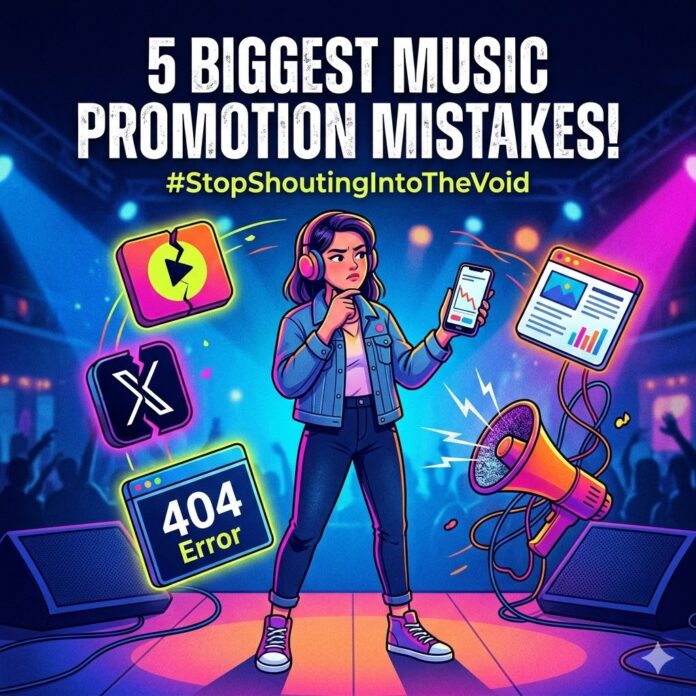
Stop me if this sounds familiar: you spend months in the studio, drop a fortune on mixing, and finally hit “submit” on your distributor. Release day comes, you post a few “Out Now” graphics on Instagram, and then… nothing. The needle barely moves, and after a week, the excitement just fizzles out.
In 2026, the music industry is more crowded than ever. The problem usually isn’t the music; it’s that most indie artists are still using a promotion playbook that stopped working three years ago.
If you feel like you’re shouting into a void, you might be falling into these five common traps. Here is how to pivot and actually get people to listen.
1. Treating Release Day Like the Finish Line
Most artists treat their release date like a grand finale. They go all-out for 24 hours and then go quiet. In reality, release day is just the starting gun. * The Reality Check: If you aren’t talking about the song two weeks after it drops, why should anyone else?
-
The Fix: Think in terms of a “Waterfall” strategy. Tease the melody weeks in advance, drop the single, and then follow up with acoustic versions, “making of” clips, and fan shoutouts for the next month. Keep the conversation going.
2. Acting Like a Digital Billboard
We’ve all seen that one artist whose entire feed is just: “Stream my new song,” “Link in bio,” “New merch.” It feels like being shouted at by a salesperson. People go to social media to be entertained or to feel a connection, not to be sold to.
-
The Fix: Follow the 80/20 rule. 80% of your content should be “the mess”—the late-night voice memos, the failed takes, or the story behind a specific lyric. Save the remaining 20% for the direct “go stream this” posts. People follow you, not just your Spotify link.
3. Obsessing Over “Empty” Streams
It’s a massive ego boost to see 50,000 streams on a track, but if those streams are coming from a “Deep Focus” or “Background Jazz” playlist, those listeners probably don’t even know your name. They aren’t fans; they’re just people who didn’t skip your song while doing their homework.
-
The Goal: You want saves and follows.
-
The Fix: Use your data to find the people who are actually adding your song to their personal playlists. 500 “super-fans” who will show up to a gig or buy a vinyl are worth way more than 50,000 passive listeners who don’t know who you are.
4. Having a “Identity Crisis” With Your Visuals
If a new listener clicks your profile and sees a moody, dark photo followed by a bright neon lyric video and then a blurry kitchen selfie, they’re going to be confused. If your “vibe” is inconsistent, your brand feels amateur.
-
The Fix: Your visuals need to sound like your music. If you’re making lo-fi indie, your photos should feel raw and nostalgic. This isn’t about being “fake”—it’s about giving people a clear way to recognize you in a crowded feed.
5. Building Your House on Rented Land
You might have 20k followers on TikTok, but you don’t actually “own” that audience—the platform does. If the algorithm changes tomorrow (or the app gets banned), you lose your connection to those fans instantly.
-
The Fix: Start a mailing list. It sounds old-school, but an email inbox is the only place where you can guarantee your fans will actually see what you have to say. Give them something exclusive—a hidden demo or a first look at a video—in exchange for their sign-up.




















 🔥 Limited Time: Get 55% OFF All Plans - Ends in: