


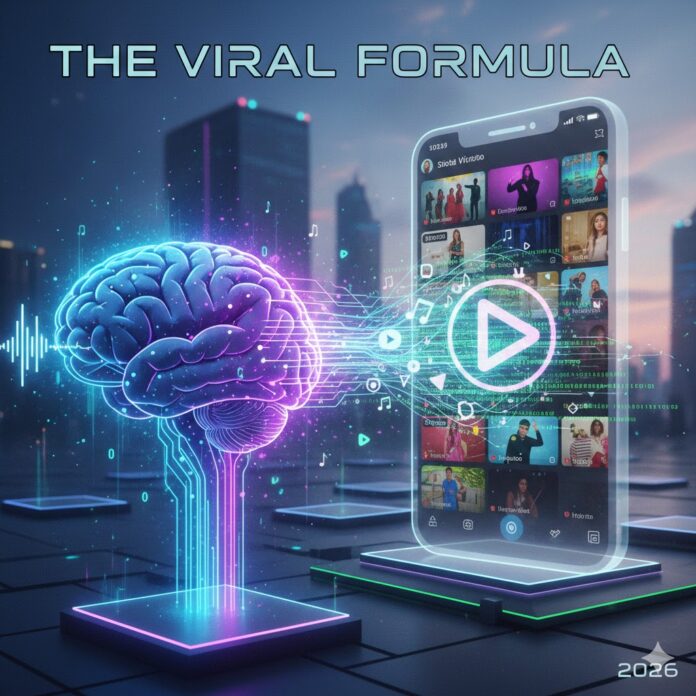
We’ve all been there—scrolling through our feeds and hearing the same catchy 15-second clip for the 50th time. You start to wonder: How did this bedroom demo from a kid in Ohio beat out the new million-dollar Drake single?
It’s easy to say “it’s just the algorithm,” but that’s a bit like saying a chef just “uses heat.” There’s a specific, slightly chaotic science to why certain songs explode while others—even the great ones—just sort of sit there.
Here is the real talk on why music goes viral in 2026.
1. The “Wait, What Was That?” Factor
In a world of infinite scrolling, your biggest enemy isn’t bad taste; it’s boredom. Songs go viral when they break the “sonic wallpaper.”
-
The “Jolt”: Think about a song like Old Town Road or any recent hyper-pop hit. They work because they sound a little “wrong” at first. Our brains are wired to pay attention to anomalies.
-
The 5-Second Audition: You no longer have three minutes to tell a story. You have five seconds to convince someone not to flick their thumb. If there isn’t a weird texture, a killer line, or a massive beat drop immediately, you’ve already lost them.
2. Is Your Song a “Tool” or Just a Song?
The cold truth is that most viral hits aren’t just listened to—they are used.
If you want a track to go nuclear, it needs to be “meme-able” or “utilitarian.” Can someone use it to show off their outfit? Can they use it to vent about their ex? Can they use it as a punchline?
-
Space for the Fan: The best songs right now leave “room” for the listener. Whether it’s an open verse for a duet or a beat that’s perfect for a transition, virality is a two-way street. You provide the raw materials; the internet builds the house.
3. The Death of Genres (and the Rise of “Vibes”)
Nobody says “I want to hear a Synth-Pop track” anymore. They say “I want to feel like I’m driving through a neon city at 2 AM while I’m slightly sad.”
The tracks that win today are Mood-First.
Pro Tip: If your song can be described as a specific “vibe” (e.g., Main Character Energy or Cottagecore Melancholy), you’re already halfway to a viral playlist.
4. The Algorithm Isn’t a Person (But It Mimics One)
We talk about “The Algorithm” like it’s a spooky ghost, but it’s actually just a mirror. It tracks Retentiveness.
If people are re-watching your 15-second clip because the loop is seamless, the algorithm thinks, “Wow, people love this,” and it feeds it to a million more people. It’s not about how many people see it; it’s about how many people can’t turn it off.
The Bottom Line
Virality is 40% talent, 40% timing, and 20% making sure your song is easy to “remix” into someone else’s life. It’s less about being the “best” musician and more about being the most relatable one.



















 🔥 Limited Time: Get 55% OFF All Plans - Ends in: