


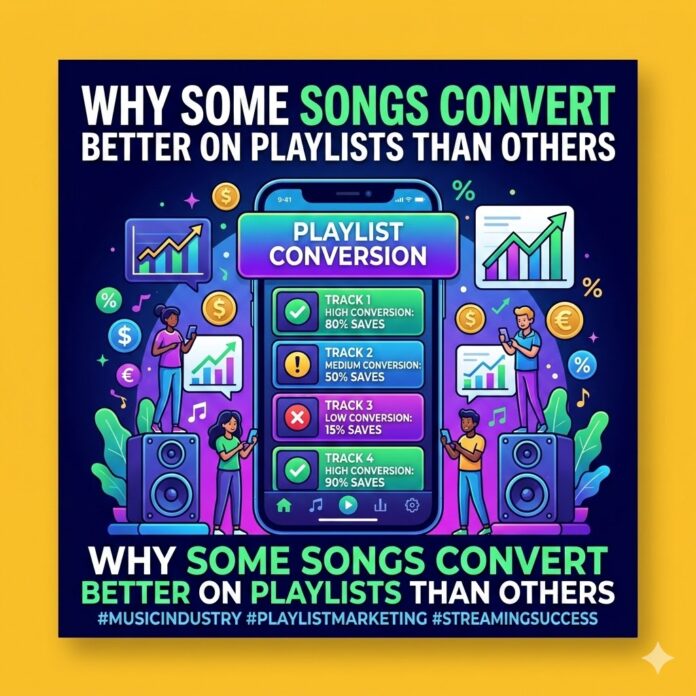
You finally land a spot on a solid playlist, the stream count starts ticking up, and you’re ready to pop the champagne. But then you check your “Saves” and “Follows,” and… nothing. Crickets.
It’s a frustrating reality of the 2026 streaming world. Getting heard is one thing, but getting kept is an entirely different beast. So, why does one song turn a casual listener into a lifelong fan while another just becomes background noise that eventually gets skipped?
Here’s the unfiltered truth about why some songs convert and others just take up space.
1. The “Don’t Bore Us, Get to the Chorus” Factor
In a world of infinite scrolling, you have about six seconds to prove you’re worth someone’s time. If your track starts with a 30-second atmospheric swell or a slow-burn drum build, you’re basically asking for a skip.
-
The Reality Check: Listeners on discovery playlists are impatient. They aren’t sitting in a dark room with headphones on; they’re driving, working out, or doing dishes.
-
The Fix: You don’t have to sacrifice your soul, but you do need a hook—vocal or melodic—within the first 10 seconds. Give them a reason to stay before they reach for the “Next” button.
2. Vibe-Matching (Read the Room)
Context is everything. You could have the best Heavy Metal track in the world, but if it accidentally ends up on a “Sunday Morning Coffee” playlist, it’s going to get nuked.
Streaming algorithms today are obsessed with contextual alignment. They look at things like:
-
BPM and Energy: Does it match the tempo of the songs around it?
-
Mood: Is the “emotional data” of your song consistent with the playlist’s intent?
If your song feels like a “jump-scare” compared to the track that played before it, the listener will skip it just to get their vibe back.
3. The “Save-to-Stream” Ratio: The Only Metric That Actually Matters
If you want to know if your song is actually “working,” ignore the total stream count for a second. Look at your Save Rate.
If 1,000 people hear your song and 100 of them hit the “Heart” icon or add it to their own library, the algorithm sees that as a massive win. It tells the platform, “Hey, this person wants to hear this again.” That’s what triggers the “Big Three” of growth: Discover Weekly, Release Radar, and Smart Shuffle.
4. Production “Loudness” (The Subconscious Quality Test)
This is a technical one, but it’s huge. If your song is mastered significantly quieter or “muddier” than the professional tracks surrounding it, the listener’s brain subconsciously registers it as “amateur.”
You don’t need a million-dollar studio, but you do need a mix that holds its own. If a listener has to reach for the volume knob when your song comes on, you’ve already lost the conversion.
Is Your Music “Sticky” Enough?
At the end of the day, a “conversion” is just a human being saying, “I need to hear this again.” | Signal | What it actually means | | :— | :— | | High Skip Rate | “This doesn’t fit the mood” or “The intro took too long.” | | High Save Rate | “I’ve found my new favorite song.” | | Low Listener-to-Follower Ratio | “I like the song, but I don’t care about the artist yet.” |
The best way to fix a conversion problem is to look at your data and be honest with yourself about the “first 10 seconds” of your tracks.



















 🔥 Limited Time: Get 55% OFF All Plans - Ends in: