


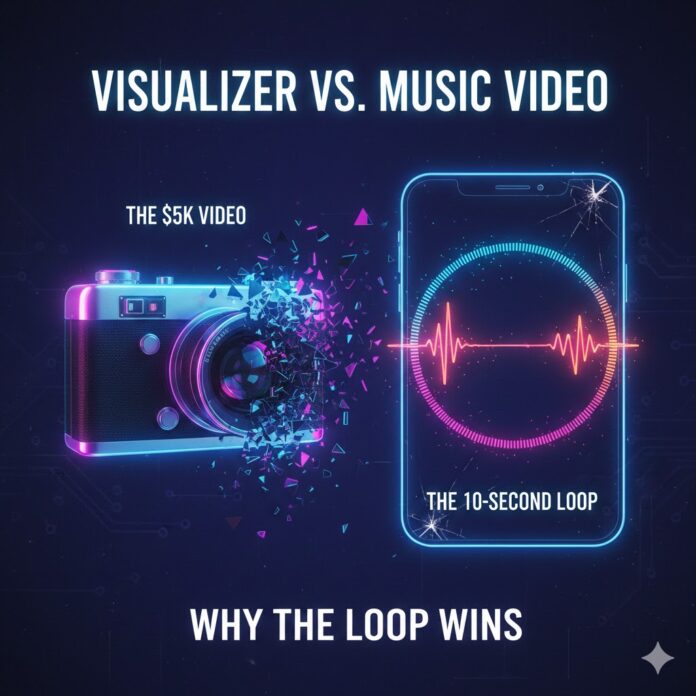
The Visualizer Pivot: Why a 10-Second Loop Often Outruns a $5k Music Video
In the “Golden Age” of music television, a high-budget music video was the ultimate flex. It was the finish line. But in today’s world of 8-second attention spans and infinite scrolling, that $5,000 cinematic masterpiece is starting to feel like a massive anchor for independent artists.
Don’t get me wrong—storytelling is great. But if you’re looking to actually move the needle on your streams without emptying your savings, the “Visualizer” (specifically a high-end, 10-second loop) is the smartest play you can make right now.
Here is the honest truth about where your money actually goes.
1. The Death of the “Sit Down and Watch” Era
Let’s be real: when was the last time you sat through a 4-minute music video from an artist you didn’t already love?
-
The Trap: You spend months on a shoot, only for people to watch the first 15 seconds on a phone and scroll past.
-
The Fix: A loop doesn’t ask for a time commitment. It’s “vibe” content. It sits in the background while the listener focuses on the music, making it the perfect companion for the way we actually consume art today.
2. Built for the “Canvas” Economy
Platforms like Spotify have changed the game with Canvas.
Tracks with a compelling 8-second loop are significantly more likely to be shared to Instagram Stories. A visualizer isn’t just a “video”—it’s a multi-tool. That one loop becomes your Spotify background, your TikTok “sounds” backdrop, and your YouTube aesthetic. You’re buying a visual identity, not just a one-off movie.
3. The Math: One “Big Swing” vs. A Full Season
Let’s look at the actual ROI:
| The $5,000 Music Video | The $500 Professional Loop |
| One “Event”: You drop it, it peaks in 48 hours, and then it’s “old news.” | Consistency: You can afford a unique loop for every single on your EP. |
| High Risk: If the song doesn’t catch fire, you’ve lost your entire marketing budget. | Low Risk: You have $4,500 left over to actually promote the song. |
| Rigid: Hard to cut into vertical content without it looking awkward. | Flexible: Designed from day one to look perfect on a phone screen. |
4. Aesthetic > Plot
In the streaming world, vibe is currency. You don’t always need a plot about a breakup or a bank heist. Sometimes, a grainy 3D render, a bit of lo-fi animation, or a stylized glitch loop sets the mood better than any actor could. It gives the listener space to feel the music themselves rather than being told exactly what to think.
The Reality Check: A “good” music video that nobody sees is just a very expensive file on your hard drive. A “great” visualizer backed by a $4,000 ad spend is a career-changer.
5. Playing the Algorithm’s Game
The algorithm rewards frequency. If you spend your whole budget on one video, you have one “moment.” If you spend it on high-quality loops for five different songs, you have five months of content. In 2026, staying in front of your audience’s face is more important than having a credit roll at the end of a video.
The Bottom Line
If you’ve got the cash to burn and a cinematic itch to scratch, go for the music video. But if you’re an artist trying to build a sustainable career, invest in the loop. It’s cheaper, it’s more shareable, and it keeps the spotlight exactly where it belongs: on the track.















 🔥 Limited Time: Get 55% OFF All Plans - Ends in: