


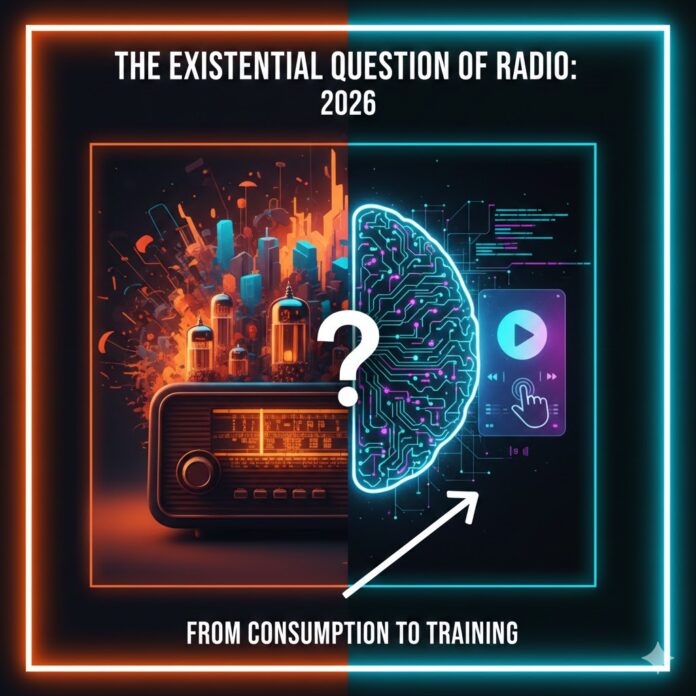
The Existential Question of Radio: Is Anyone Still Listening for the Music?
By 2026, we were supposed to be done with the FM dial. The narrative was simple: algorithms would become so psychic, so perfectly tuned to our dopamine receptors, that the idea of a “broadcast”—one signal sent to thousands of people regardless of their individual tastes—would feel like a relic of the stone age.
But a funny thing happened on the way to the digital utopia. As we shifted from passive consumption to what experts call “training-based access,” we didn’t just lose the static; we lost the soul of discovery.
From “What’s On?” to “How Have I Trained It?”
Think about how you find music today. You don’t just “listen” to a streaming service; you work it. You skip the tracks that don’t fit your mood, you “heart” the ones that do, and you effectively train an AI to build a sonic mirror of your existing tastes.
This is training-based access. It’s efficient, it’s personalized, and it’s incredibly lonely. It creates a feedback loop where you’re rarely challenged and almost never surprised. You aren’t discovering music; you’re just refining a preference.
The Power of the “Human Pivot”
This is exactly where traditional broadcasting is finding its second wind in 2026. The existential crisis of radio has actually revealed its greatest strength: it doesn’t care what you think.
There is a growing “algorithm fatigue” setting in. We’re tired of being understood by software. There’s a certain magic in the “human pivot”—that moment when a live DJ plays a track that your data says you should hate, but because of the context, the timing, or the story they tell before the needle drops, you end up loving it.
Traditional radio is the last bastion of the shared experience. In a world of hyper-personalized bubbles, broadcasting is the only thing left that reminds us we’re part of a community, listening to the same song, at the exact same moment, in the same city.
Why the Dial is Still Turning
Is radio still relevant for discovery? If discovery means “finding a song that fits my existing data profile,” then no—the robots have won that round.
But if discovery means “being introduced to something I didn’t know I needed,” then radio is more vital than ever. In 2026, we’re seeing a massive resurgence in local broadcasting. People are craving:
-
The “Why,” not just the “What”: Context from a human who knows the artist’s history.
-
Localism: Finding out about a show happening three miles away, not a global tour.
-
Serendipity: The joy of a happy accident that wasn’t calculated by a server farm in Northern Virginia.
The Bottom Line
We’ve spent the last decade training our devices to give us exactly what we want. But in 2026, we’re realizing that what we want isn’t always what we need. Traditional broadcasting isn’t an outdated technology; it’s a necessary break from the machine. It’s the sound of a human being saying, “Hey, listen to this—I think you’ll like it.”
And as it turns out, that’s a signal that won’t ever go completely silent.


















 🔥 Limited Time: Get 55% OFF All Plans - Ends in: