


Decoding the “Source of Streams”: What Your Spotify Data is Actually Trying to Tell You
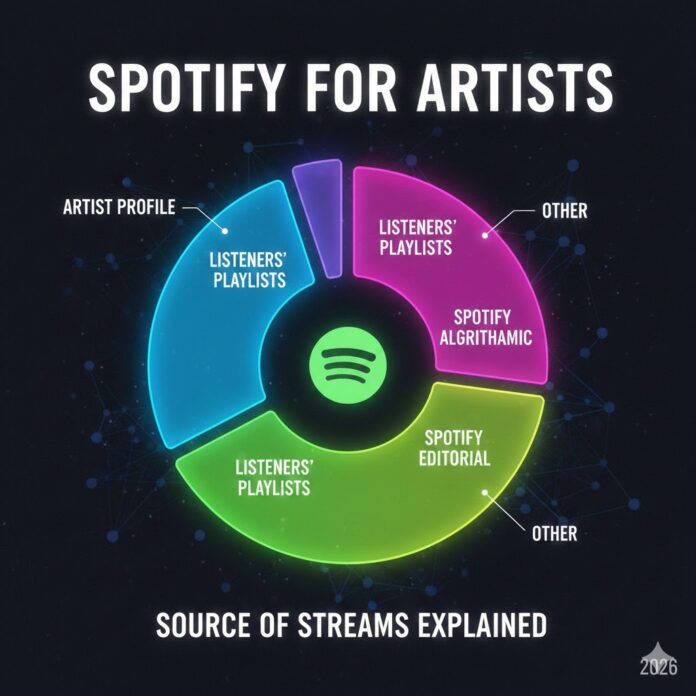
If you’ve spent any time in the Spotify for Artists dashboard lately, you’ve likely stared at that colorful pie chart labeled Source of Streams. It’s easy to look at a spike in numbers and feel like you’re “winning,” but if you don’t know where those plays are coming from, you’re essentially flying a plane without a dashboard.
In 2026, the game isn’t just about getting more streams—it’s about getting the right kind of streams. Let’s pull back the curtain on what those slices actually mean for your career longevity.
1. Your Profile and Catalog (The “Superfans”)
When this slice is big, take a bow. This represents listeners who took the time to search for your name or click through to your profile.
-
The Reality Check: These aren’t accidental listeners. They are your core fanbase. If this section is growing, your “off-platform” work—like your TikToks, IG Stories, or touring—is actually converting people into real fans.
-
The Goal: You want this to be a healthy chunk. It’s the best insurance policy against a fickle algorithm.
2. Listeners’ Own Playlists and Library (The “Sticky” Metric)
This is arguably the most important slice for long-term success. It covers every time someone hits the “heart” icon or adds you to their “Gym 2026” or “Late Night Drive” playlist.
-
Why it Matters: This is retention. It tells Spotify’s AI, “Hey, people don’t just like this song—they want to hear it again.” * The Insider Secret: High numbers here are what trigger the algorithm to start working for you. If people are saving your track, Spotify feels “safe” recommending it to strangers.
3. Spotify Algorithmic (The “Growth Machine”)
This is where Discover Weekly, Release Radar, and Radio live.
-
The Vibe: Think of this as Spotify’s “Free Marketing.” When the algorithm sees that your Save-to-Stream ratio is high (from the section above), it starts pushing you to similar listeners.
-
The Warning: Don’t rely only on this. If the algorithm stops “liking” your song tomorrow, your streams will crater. You need a balance of active fans to keep the machine fed.
4. Spotify Editorial (The “Status Symbol”)
Ah, the dream: landing on New Music Friday or Front Left.
-
The Cold Truth: Editorial placements are great for the ego and the bank account, but they are often “passive” streams. People listen to these playlists because they trust the playlist, not necessarily because they know you.
-
The Strategy: If you land a big editorial, your only job is to convert those passive listeners into followers so they show up in your “Artist Profile” slice next month.
Active vs. Programmed: The Real Battle
Spotify essentially looks at your music in two ways:
| Stream Type | The Breakdown | The Sentiment |
| Active | Searches, Profile visits, Personal Playlists | “I love this artist.” |
| Programmed | Radio, Autoplay, Editorial | “This is a good vibe.” |
The sweet spot? You want a healthy mix. If you’re 90% Programmed, you’re a “background noise” artist. If you’re 90% Active, you have a cult following but aren’t reaching enough new people.
How to Tilt the Pie Chart in Your Favor
-
Stop chasing “Big” playlists: 100 saves from a small, niche personal playlist are worth more to the algorithm than 1,000 streams from a “Top Hits” bot playlist.
-
Use your “Link in Bio” wisely: Don’t just send people to your song; send them to your Artist Profile. It encourages the “Follow” button, which fuels your Release Radar.
-
Master the 30-Second Rule: If listeners skip your song in the first 30 seconds of a Radio play, Spotify thinks your music is “low quality” for that mood. Make sure your intros are engaging.
The Bottom Line
Your “Source of Streams” isn’t just a report card—it’s a diagnostic tool. If your “Listeners’ Own Playlists” slice is shrinking, it’s time to look at your songwriting or production. If your “Profile” slice is tiny, it’s time to get louder on social media.




















 🔥 Limited Time: Get 55% OFF All Plans - Ends in: