


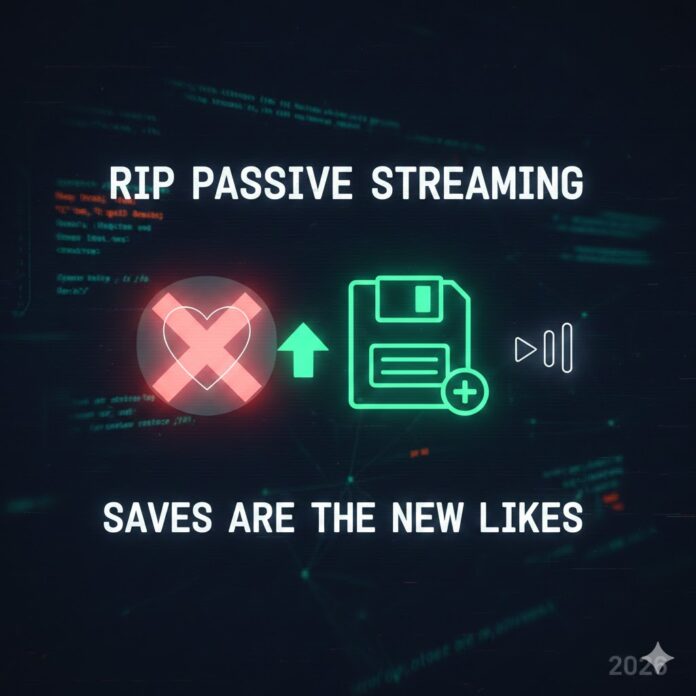
RIP Passive Streaming: Why “Saves” Are the New “Likes” in 2026
The era of “background noise” is officially over. If you’ve noticed your streaming numbers plateauing despite a high follower count, you’re likely a victim of the 2026 Algorithmic Shift.
For years, we obsessed over “Likes” and “Monthly Listeners.” But as AI-driven platforms like Spotify, Apple Music, and TikTok have evolved, they’ve realized that a “Like” is often a passive, low-value micro-action. In 2026, the algorithms have a new king: Active Engagement.
Here’s why Saves are the new Likes, and how you can pivot your strategy to survive the “Passive Streaming” purge.
The Death of the “Lean-Back” Listener
In the early 2020s, “getting on a playlist” was the ultimate goal. But many of those streams were passive—people cleaning their houses or studying while a Lo-Fi beat played in the background.
The 2026 Reality: Platforms now prioritize Retention and Intent. If a user listens to your track once on an editorial playlist but never interacts with it again, the algorithm marks that as “passive noise.” High stream counts with low “Save” rates now actually hurt your visibility, signaling to the AI that your music isn’t “sticky” enough to recommend to others.
Why “Saves” Outrank Everything Else
A “Save” (adding to a library or a personal playlist) is a high-intent signal. It tells the algorithm:
-
Intent to Return: The user wants to hear this again.
-
Personal Value: This track is worth “real estate” in their private collection.
-
Algorithmic Trust: The AI now has permission to push your song into Discover Weekly and Release Radar for similar profiles.
2026 Algorithm Ranking Factors: The New Hierarchy
Based on current data, here is how streaming platforms are weighting user actions this year:
| Priority | Action | Algorithmic Impact |
| CRITICAL | Personal Playlist Add / Save | Highest: Triggers automated discovery loops. |
| HIGH | Repeat Plays | Signals “Obsession” and high retention. |
| MEDIUM | Full Completion | Prevents your track from being flagged as “skip-bait.” |
| LOW | Likes / Hearts | Now seen as a vanity metric with low predictive value. |
| NEGATIVE | Early Skips (<30s) | Drastically reduces your reach in the first 48 hours. |
3 Strategies to Boost Your “Save-to-Stream” Ratio
To win in 2026, you have to stop asking for “plays” and start asking for commitments.
1. The “Hook-First” Arrangement
The 2026 algorithm measures engagement from the first 10 seconds. Long, atmospheric intros are “reach killers.” If you don’t capture the listener’s intent immediately, they won’t stay long enough to hit the “Save” button. Start your tracks with your strongest melody or a compelling vocal hook to lower your skip rate.
2. Incentivize “Library Real Estate”
When promoting on social media (TikTok/Reels), your Call to Action (CTA) shouldn’t be “Listen to my new song.” Instead, try:
“Add this to your ‘Late Night Drives’ playlist so you don’t lose it.”
By framing the save as a way for the user to organize their own life, you increase the likelihood of a high-intent action.
3. The “Deep-Curation” Pitch
When pitching to independent curators, stop looking for “Big Playlists.” Look for Niche Intent Playlists. A placement on a “Japanese City Pop for Gaming” list with 500 active savers is 10x more valuable than a “Top Hits 2026” list where people just let the music run in the background.
The Verdict: Quality Over Quantity
The “Passive Streaming RIP” isn’t a death sentence for artists; it’s a filter. It rewards creators who build genuine connections and “sticky” music over those who rely on bot-inflated numbers or background vibes.


















 🔥 Limited Time: Get 55% OFF All Plans - Ends in: