


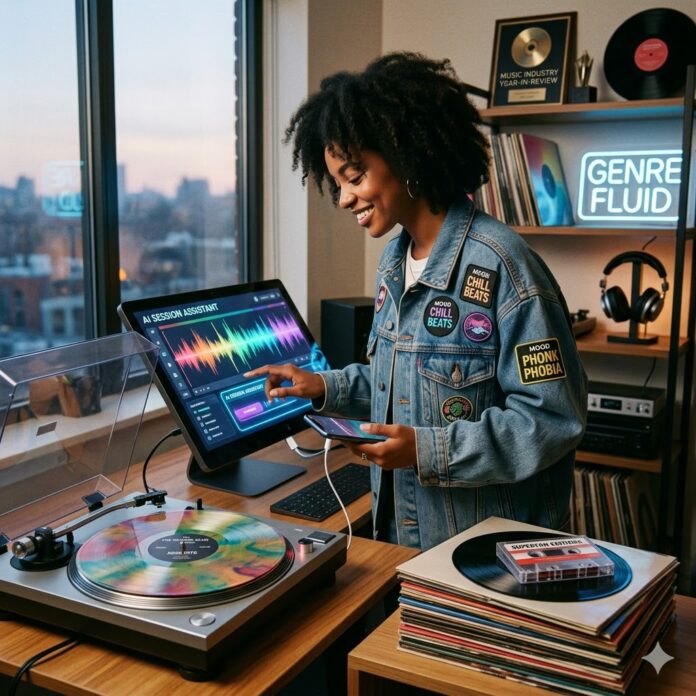
The music industry didn’t just change over the last year—it feel like it’s been completely rebuilt. As we settle into 2026, the dust from 2025’s massive shifts is finally starting to clear, and it’s revealing a landscape that looks a lot different for artists, labels, and fans alike.
From the “instant” billion-stream milestones to the reality of AI in the studio, here’s a look at what actually moved the needle this past year.
1. The Death of the “Slow Burn”
Remember when a hit song took a year to truly saturate the culture? Those days are gone. In 2025, the average time for a massive track to hit a billion streams dropped to just under 200 days.
It’s an incredible pace, but it’s a double-edged sword. While algorithmic feeds on TikTok and Reels are acting as global rocket fuel, artists are feeling the pressure to churn out content faster than ever just to stay in the conversation.
2. AI: From “Villain” to “Studio Assistant”
The panic of 2024 has largely cooled off, replaced by a more practical—if still complicated—relationship with technology. We’ve moved past the era of “fake” Drake songs and into the era of the AI co-pilot.
-
Cleaning up the Workflow: Producers are using generative tools to handle the tedious stuff, like fixing session compatibility or generating basic melodic foundations to spark an idea.
-
The Rules of the Game: We finally have some clarity from the copyright offices. The line is being drawn: if a machine wrote it, you can’t own it. This is forcing the industry to prioritize human soul and “story” over perfect, computer-generated polish.
3. The Superfan is the New MVP
Streaming still pays the bills (accounting for nearly 70% of industry revenue), but it doesn’t build a career. That’s where the “Superfan” comes in.
Despite spending half their lives on digital platforms, Gen Z is leading a massive Physical Renaissance.
-
Vinyl is King: Sales grew by another 10% this year.
-
The “Vibe” Factor: For many, buying a record isn’t about the audio quality—it’s about having something real to hold. It’s a way to actually own a piece of the music in a world where everything else is rented.
Comparison: The Digital vs. Physical Split
| Focus | Streaming | Physical Media |
| Usage | Discovery & Playlists | Connection & Collection |
| Vibe | Convenience | Tangibility |
| Trend | Global Reach | Community Support |
4. Mood Over Genre
We’re seeing the “Genre Box” disappear in real-time. Most listeners don’t say “I like Indie Rock” anymore; they say “I want something to study to” or “I need something for a late-night drive.”
-
The Rise of “Dark” Pop: Interestingly, while “chill” music is still huge for background noise, the biggest hits of the last year leaned into moody, introspective, and darker tones.
-
Global Fusion: Regional sounds like Amapiano and Phonk are no longer “niche”—they’re headlining major festivals and blending into mainstream production.
5. The Hybrid Stage
Touring has become incredibly expensive, which has forced artists to get creative. We’re seeing a shift toward Hybrid Performances.
-
Beyond the Venue: Whether it’s an interactive livestream or a Discord-exclusive “backstage” set, artists are finding ways to reach fans without the massive overhead of a 40-city bus tour.
-
Community First: The most successful artists right now aren’t just “performers”—they’re community leaders who interact with their fans daily, not just when they have a new single to sell.
What’s the Takeaway for 2026?
The industry is moving away from “going viral” as a goal and moving toward sustainability. It’s about using the tech to help the craft, but keeping the human element at the very center of the song.













 🔥 Limited Time: Get 55% OFF All Plans - Ends in: