


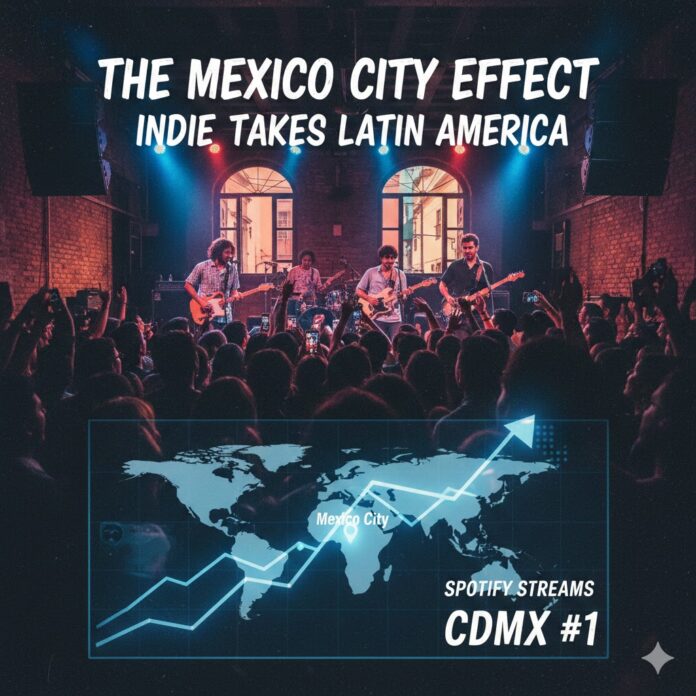
The “Mexico City” Effect: Why Every Indie Band is Suddenly Huge in Latin America
If you’ve spent five minutes on Spotify’s artist dashboard lately, you’ve seen it. That little “Top Cities” widget—the one that’s supposed to show a band’s home turf—is increasingly dominated by one place: Mexico City.
It doesn’t matter if the band is a post-punk trio from Leeds or a lo-fi bedroom pop project from Portland. Somewhere along the way, Mexico City became the undisputed “Main Character” of the global indie scene. This isn’t just a fun stat for a slide deck; it’s a career-altering shift that musicians are calling the “Mexico City Effect.”
More Than Just a “Streaming Hub”
For a long time, industry suits talked about Latin America as a “developing market.” That’s a massive understatement. In 2026, CDMX isn’t developing; it’s leading.
The city has more Spotify users than New York, London, or Los Angeles. But the “Effect” isn’t just about raw numbers—it’s about intensity. In a world where Western audiences are often “too cool” to look up from their phones at a gig, Latin American fans are famously, beautifully obsessive.
“In London, you might get a polite nod. In Mexico City, you get 2,000 people screaming every word to a B-side you wrote in your garage three years ago.”
The Algorithmic Loophole
Here’s where it gets interesting for the DIY crowd. Because the volume of listeners in Mexico is so high, a small spark there turns into a wildfire quickly.
When a band starts trending in CDMX, the Spotify algorithm notices the “velocity” of the data. It assumes the band is the next big thing and starts shoving them into global playlists. Essentially, blowing up in Mexico is the ultimate “cheat code” for getting noticed in America and Europe.
Why It’s Happening Now
It’s the perfect storm of a few things:
-
The Post-Genre Generation: Mexican youth culture doesn’t care about the old “rock vs. pop” divides. They’re hungry for anything that feels authentic, whether it’s shoegaze or psych-rock.
-
The Digital Nomad Influx: As CDMX has become a hub for international creatives, the cross-pollination of tastes has hit hyperdrive.
-
A Culture of Curation: Local promoters and radio stations (shout out to Reactor 105.7) are still actual tastemakers who take risks on weird, independent sounds.
What This Means for the Music
We’re starting to see the “reverse commute.” Instead of Mexican bands trying to break into the US, we see US and UK bands desperate to prove they can sell out a room in the Roma Norte neighborhood.
The result? The sound of indie music is changing. It’s becoming more global, more rhythmic, and less focused on the “Brooklyn bubble.”
The Bottom Line
If you’re an artist and you aren’t looking South, you’re looking the wrong way. The gatekeepers have changed. The tastemakers aren’t in a glass office in London; they’re in a crowded club in CDMX, and they’re louder than any PR campaign could ever be.


















 🔥 Limited Time: Get 55% OFF All Plans - Ends in: