


How to Market Your Art When You’re Living on a “Starving Artist” Budget
Let’s be real: most of us didn’t get into art because we loved the idea of managing spreadsheets and running ad campaigns. And when you’re staring at a bank account that barely covers your next roll of canvas or bag of clay, the word “marketing” can feel pretty intimidating.
The good news? The internet has leveled the playing field. You don’t need a fancy gallery rep or a $5,000 ad spend to get your work in front of people who will actually buy it. You just need a bit of grit and a solid game plan.
Here is how to move the needle without spending a fortune.
1. Stop Being “Polished” and Start Being Real
People don’t just buy art; they buy the person behind the art. While it’s tempting to only post high-res photos of your finished pieces, that’s actually the hardest way to grow on social media right now.
-
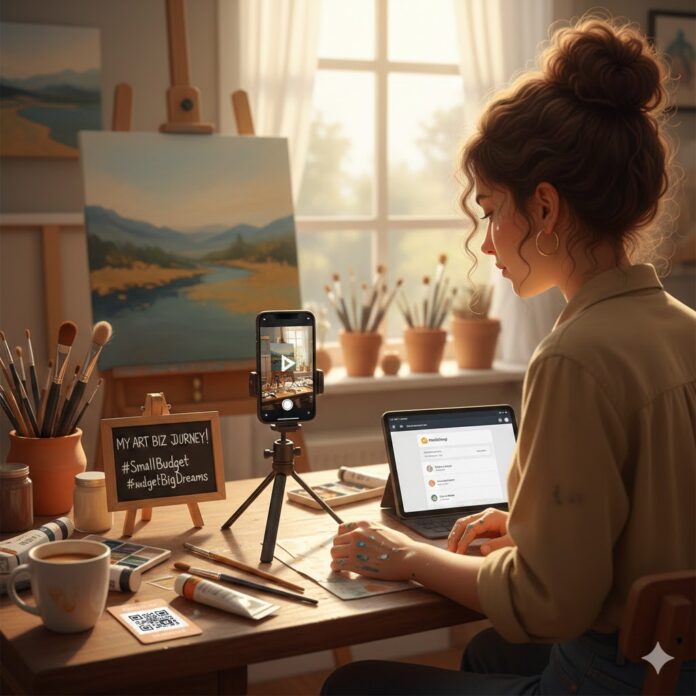
Show the mess: People love seeing the “ugly middle phase” of a painting. Prop your phone up against a coffee mug and film a 15-second clip of you mixing colors or cleaning your brushes.
-
Talk to the camera: I know, it’s awkward. But showing your face and explaining why you painted something creates a connection that a sterile “Buy Now” caption never will.
-
Keep it cheap: You don’t need a lighting rig. Move your desk next to a window and use free versions of apps like CapCut to stitch clips together.
2. The “Old School” Email List
Social media is rented land. If Instagram disappeared tomorrow, would you lose your entire customer base? This is why you need an email list.
-
The Hook: Nobody signs up for a “newsletter” anymore. Give them a reason. Offer a free digital download, a “behind the scenes” studio tour video, or a small discount on their first print.
-
Keep it simple: You don’t need a fancy template. Just a personal note every few weeks showing what you’re working on is enough to keep you top-of-mind when someone is finally ready to buy.
3. Think “Hyper-Local”
Before you try to go viral globally, try to become the “local artist” in your zip code. It’s way less crowded and much more supportive.
-
Coffee Shop Galleries: Most local cafes are tired of looking at empty walls. Approach them about a “rotation”—you provide the art, they provide the wall space, and you both win.
-
The QR Code Trick: If you hang art in a public space, don’t just leave a business card. Put up a small sign with a QR code that goes straight to your Instagram or shop. It makes the “impulse follow” effortless.
4. Collaborate with “Art Cousins”
Find artists who aren’t doing exactly what you do, but share your vibe. If you make handmade jewelry, find someone who makes organic linen clothing.
-
The Cross-Pollination: Do a joint giveaway or a “Studio Swap” on Instagram Stories. You’re essentially introducing your audience to them and vice versa. It’s free marketing to a group of people who are already primed to like what you do.
5. Be “Google Friendly” (Without the Headache)
You don’t need to be a tech genius to handle SEO. Just stop naming your files “IMG_402.jpg.”
-
Describe your work for a blind person: When you upload art to your site, use the “Alt-Text” or “Description” box. Instead of “Blue Painting,” try “Deep blue abstract ocean wave oil painting for living room decor.” That’s what people actually type into Google.
-
Blog about your “How-To”: If you have a website, write a post about how you choose your color palettes or how to care for original paintings. These posts act as “magnets” that bring people to your site through search.
The Bottom Line: Be Consistent, Not Perfect
Marketing isn’t a one-time event; it’s a habit. You’re better off posting one raw, honest video a week than spending three months (and $200) on a “perfect” ad that feels corporate and cold.
Your budget might be small, but your story is unique. Lean into that.


















 🔥 Limited Time: Get 55% OFF All Plans - Ends in: