


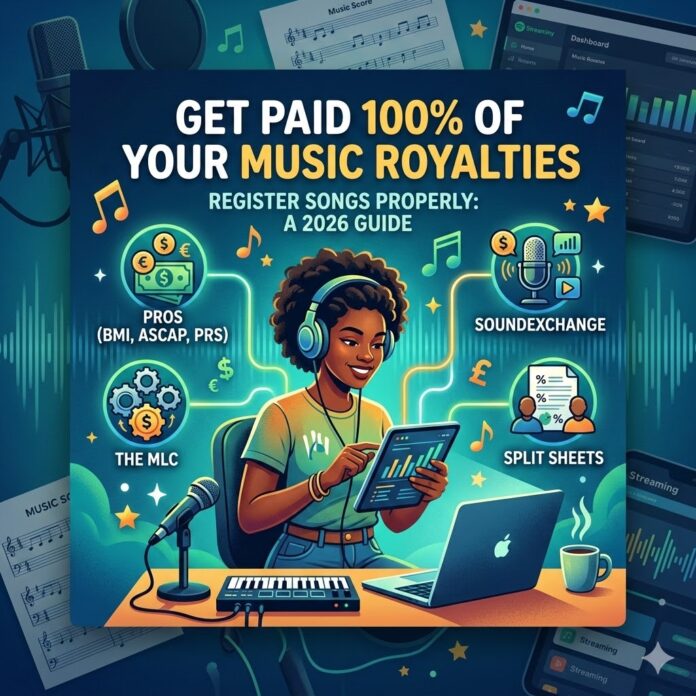
You just finished a killer track, and the last thing you want to do is fill out government-style paperwork. But here’s the cold, hard truth: Getting your music on Spotify is not the same thing as getting paid.
If you only use a distributor like DistroKid or TuneCore, you are leaving about half your money on the table. That money doesn’t just disappear; it sits in a “black box” until the government eventually hands it over to the major labels because nobody claimed it.
Let’s fix that. Here is the “no-nonsense” guide to actually owning your career in 2026.
1. The “Awkward” Conversation (Split Sheets)
Before the song even leaves the studio, you need to talk to your collaborators. Don’t “do it later”—later never happens. A Split Sheet is just a simple document where everyone agrees on who owns what.
-
The Song (Lyrics/Melody): Usually split between the writers and producers.
-
The Master (The Recording): Usually owned by whoever paid for the session.
If you don’t have this in writing, a single dispute can freeze your royalties for years. Get it signed, scan it, and save it to the cloud.
2. Don’t just “Distribute”—Register
Your distributor (DistroKid, TuneCore, etc.) only collects Master Royalties. They don’t touch your Publishing Royalties. To get that other half of the pie, you need to be in two specific places:
The PRO (Performance Rights)
Think of BMI, ASCAP, or PRS. These folks collect money whenever your song is played “in public.” This includes radio, bars, and yes, even when someone hits play on a Spotify playlist.
-
Action: Pick one (BMI is free for songwriters; ASCAP has a one-time fee) and register your works immediately.
The MLC (Mechanical Royalties)
This is where most indie artists mess up. Every time your song is streamed, it generates a “mechanical” royalty. In the U.S., the Mechanical Licensing Collective (The MLC) handles this.
-
Action: If you aren’t registered here, your streaming mechanicals are literally sitting in a vault waiting for you.
3. The “Hidden” Money: SoundExchange
This one is a total game-changer. SoundExchange is separate from everything else. They collect royalties from “non-interactive” digital radio—stuff like SiriusXM, Pandora, or iHeartRadio.
The beautiful part? They pay the performer, not just the songwriter. If you sang on the track or played guitar, you have money waiting here. It’s free to join, and they often have a backlog of “unclaimed” royalties waiting for you to verify your identity.
4. The “I Hate Paperwork” Option
If reading all this makes your head spin, you can hire a Publishing Administrator like Songtrust or Sentric.
-
The Good: They do all the registering for you (PRO, MLC, international societies) for a small fee or percentage.
-
The Bad: They take a cut (usually 15-20%) and it can take 6–12 months for the money to start flowing.
It’s a trade-off: your time vs. your money. If you’re prolific and hate spreadsheets, a Pub Admin is your best friend.
Your 2026 “Get Paid” Checklist
-
[ ] Sign a Split Sheet (No handshake deals!)
-
[ ] Register with a PRO (BMI/ASCAP)
-
[ ] Register with The MLC
-
[ ] Sign up for SoundExchange
-
[ ] Double-check your Metadata (Make sure your name is spelled the same way everywhere)



















 🔥 Limited Time: Get 55% OFF All Plans - Ends in: