


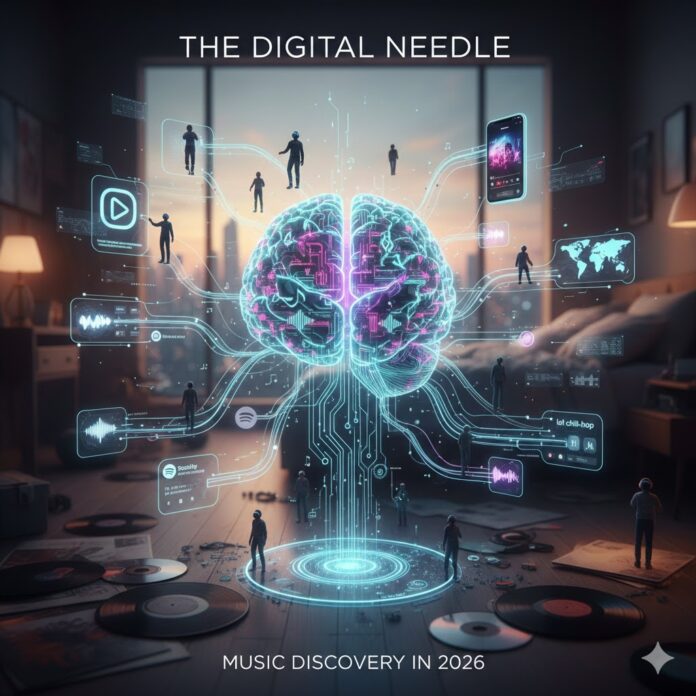
The Death of the Record Store Clerk: How We Actually Find Music in 2026
There was a time—not that long ago—when finding a new favorite band felt like a mission. You’d spend an hour at a local shop flipping through bins, or you’d wait by the radio with a blank cassette tape, hoping the DJ would finally play that one song you heard at a party.
Now? We don’t find music anymore. Music finds us.
By 2026, the way we “discover” sounds has shifted from a conscious hunt to a passive, AI-powered experience. It’s convenient, sure, but it’s also fundamentally changed what we listen to and how artists even write songs. Let’s talk about how we got here.
1. The Algorithm is Your New Best Friend (and Roommate)
Remember when you’d ask a friend, “What are you into lately?” Now, we just let Spotify or Apple Music tell us.
The “Discover Weekly” model has evolved. In 2026, these platforms aren’t just looking at what genres you like; they’re looking at your behavioral data. If you skip a song in the first five seconds, the algorithm takes a mental note. If you play a track on repeat three times, it starts looking for “sonic siblings”—songs with the same BPM, key, and even the same vocal texture.
It’s efficient, but it’s created a “30-second hook” culture. If an artist doesn’t grab you immediately, they’re gone. The slow-burn intro? It’s basically an endangered species.
2. We’re Listening to “Vibes,” Not Genres
Nobody says “I only listen to Heavy Metal” anymore. We’ve become a “mood-first” society.
Streaming has popularized the contextual playlist. We have tracks for “Main Character Energy,” “Deep Focus Work,” or “Rainy Sunday Coffee.” Because of this:
-
Genre-blending is the norm. Since we’re searching for a “feeling” rather than a category, artists are mixing jazz, lo-fi, and country without a second thought.
-
Music is utilitarian. For many of us, music has become a tool to help us do something else (study, sleep, gym) rather than the main event.
3. The “TikTok Effect” is Only Getting Stronger
If you’re wondering why a random indie song from 1974 is suddenly #1 on the charts, look at your phone.
In 2026, short-form video (TikTok, Reels, Shorts) acts as the ultimate filter. A song doesn’t need a million-dollar marketing budget anymore; it just needs to be the perfect background for a 15-second “day in the life” video.
This has democratized fame. A kid in their bedroom in Jakarta can go viral and end up on a global editorial playlist by Tuesday. The gatekeepers didn’t just lose their keys; the whole gate was torn down.
4. The World Got Smaller (In a Good Way)
One of the best things about the streaming era is that the “language barrier” is effectively dead.
Ten years ago, it was rare for a non-English track to dominate the US or UK charts. Now, thanks to the way streaming apps recommend “similar artists” globally, fans are jumping from Western pop to K-Pop, Afrobeats, and Bad Bunny without missing a beat. We’re finally listening to the whole world, not just our own backyard.
The Bottom Line: Is Discovery “Better” Now?
We’ve traded the thrill of the hunt for infinite choice.
On one hand, you’ll never run out of music. On the other, with 100,000+ songs uploaded every single day, it’s easy for great art to get lost in the noise. We’ve become remarkably good at finding “more of what we already like,” but maybe a little worse at stepping outside our comfort zones.
Next time your “Daily Mix” hits you with a perfect track, take a second to look up the artist. In a world of algorithms, the most “human” thing you can do is actually learn the name behind the song.

















 🔥 Limited Time: Get 55% OFF All Plans - Ends in: