


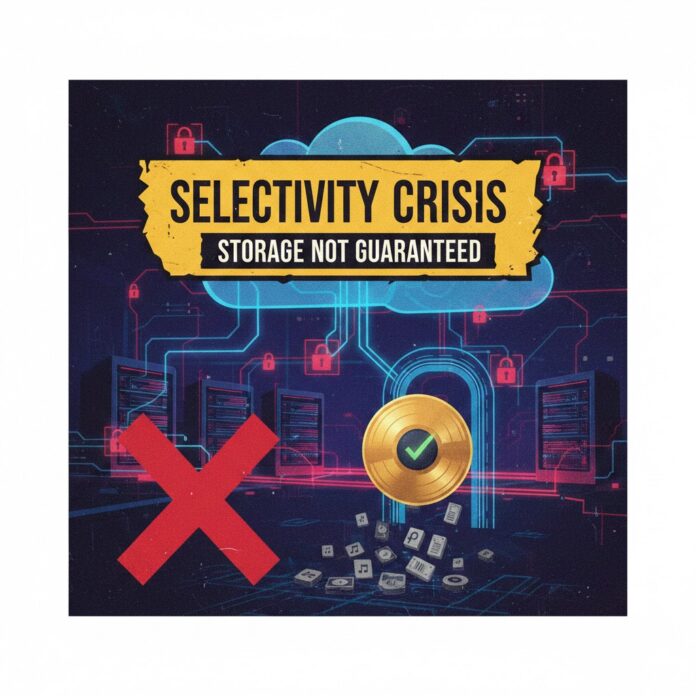
The End of the “Upload and Hope” Era: Is Your Music About to Be Evicted?
For the last decade, we’ve been living in the Wild West of music distribution. If you had twenty bucks and a DistroKid account, you were in. Your bedroom pop demo lived on the exact same digital shelf as a Beyoncé record. It was the ultimate democratization of art.
But that open-door policy is starting to creak under its own weight.
We are heading toward what industry insiders are calling the DSP Selectivity Crisis. And if you aren’t paying attention, you might wake up to a world where “uploading” your music isn’t enough—you might actually have to audition just to get your tracks stored on a major platform.
The Cloud is Full (Sort Of)
We like to think of the “Cloud” as this infinite, ethereal void. It’s not. It’s a series of massive, air-conditioned warehouses full of servers that cost a fortune to run.
Right now, over 100,000 tracks are uploaded to streaming services every single day. A huge chunk of that is “digital noise”—white noise loops, AI-generated “slop,” and tracks that will literally never get a single play. For a company like Spotify or Apple Music, hosting a track that earns $0 but costs $0.05 in server maintenance is a bad business move.
We’ve already seen the first shot across the bow: Spotify’s 1,000-stream minimum for royalties. But the next step isn’t just about who gets paid; it’s about who gets admitted.
The “Pitch” for Permanent Residence
Imagine a future where your distributor sends your song to a DSP, and the response is: “No thanks.”
This is Selective Ingestion. Instead of a platform being a library of every song ever recorded, it becomes a curated gallery. To get in, you might soon need to prove:
-
Search Intent: Are people actually looking for you, or are you just filler?
-
A “Clean” Record: Is your metadata perfect? Or is it messy enough to be flagged as spam?
-
Proof of Pulse: Do you have an active audience elsewhere (TikTok, IG, etc.) that will follow you to the app?
In this world, the “Pitch” isn’t just for a spot on New Music Friday. It’s a pitch just to exist in the database.
Why This Should Keep You Up at Night
If you’re an independent artist, this is the return of the gatekeeper—only this time, the gatekeeper is an algorithm with a calculator.
The danger is that the “long tail” of music—the weird, experimental, and niche stuff—gets chopped off. If you aren’t an immediate “win” for the platform’s bottom line, you could be relegated to second-tier sites or decentralized platforms, while the major DSPs become walled gardens for established stars.
How to Stay “Un-evictable”
You can’t control the platforms, but you can control your “stickiness.” Here is how you survive the Selectivity Crisis:
-
Own Your Audience: If you don’t have an email list or a direct way to message your fans, you’re playing a dangerous game. You need to be able to tell your fans where to go if the “Big Three” apps stop hosting you.
-
Make People Search for You: Passive streams (playlists) are great, but “Active” streams are gold. When someone types your name into a search bar, you become a high-value asset to the DSP.
-
Treat Your Metadata Like a Resume: Don’t get lazy. High-quality credits, ISRC codes, and verified bios make you look like a professional, not a spammer.
-
Expect the Pitch: Stop thinking of your release as a “drop.” Start thinking of it as a proposal. Why does this song deserve to take up space on a server? If you can’t answer that, the algorithm will eventually answer it for you.
The Bottom Line
The era of infinite hosting is ending. The DSPs are tired of paying for digital clutter, and they’re starting to look for reasons to say “no.”
The goal for 2025 and beyond isn’t just to make music; it’s to make music that a platform can’t afford to delete.
















 🔥 Limited Time: Get 55% OFF All Plans - Ends in: