


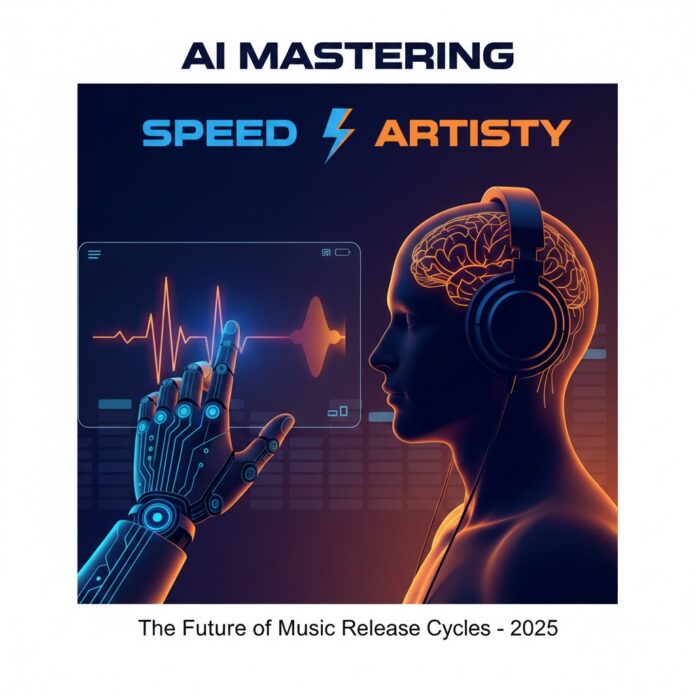
🤖 The AI Revolution in Music: Accelerating Release Cycles with Services like LANDR 🚀
The music industry in 2025 is moving faster than ever. For independent artists and labels, the pressure to maintain a consistent release schedule is intense. The final, crucial step in this process—audio mastering—used to be a significant bottleneck.
Enter AI mastering services like LANDR. These revolutionary platforms are dramatically changing the game, turning a multi-day process into a matter of minutes, while simultaneously driving down costs. But as speed and accessibility surge, the industry is grappling with a fundamental question: Can algorithms truly replace the nuanced artistry of a human mastering engineer?
⚡ The AI Advantage: Speed, Cost, and Accessibility
AI-driven mastering is fundamentally rewriting the timeline for music releases. By using machine learning, platforms like LANDR analyze a track’s frequency balance, dynamics, and loudness, then apply a custom processing chain to optimize it for streaming services like Spotify and Apple Music—all in mere seconds.
Here’s how this automated approach is disrupting the traditional release cycle:
1. Hyper-Accelerated Production Time
-
Human Mastering: Typically involves scheduling, waiting for the engineer’s queue, and a review/revision process that can take several days to a week.
-
AI Mastering (e.g., LANDR): Offers instantaneous masters. Artists can upload a mix, receive a professional-quality master in under a minute, and move immediately to distribution. This speed is critical in a content-hungry market where timely releases are key to viral success and playlist placement.
2. Dramatic Cost Reduction & Democratization
-
Traditional Mastering: Can cost anywhere from $50 to $500 per track, making full albums prohibitively expensive for most independent artists.
-
AI Mastering: Services are subscription-based and often offer unlimited masters for a low monthly fee (e.g., LANDR offers plans for a fraction of the cost of a single professional master). This democratizes high-quality audio, making a polished, release-ready sound accessible to bedroom producers globally.
3. Perfect Consistency for Albums
AI mastering tools excel at technical consistency. For an EP or album, they ensure every track is perfectly matched in terms of overall loudness (LUFS), tone, and dynamic range—a task that requires meticulous attention from a human, which can sometimes be affected by ear fatigue.
🧐 The Quality Concern: The Art vs. The Algorithm
While AI offers undeniable efficiency, the most significant debate in 2025 centers on quality. Many audio professionals and listeners argue that the human element is irreplaceable.
⚠️ The Risk of “Good Enough” and Homogenization
AI systems are trained on massive datasets of successfully mastered music. While they can perfectly replicate the statistics of a commercially successful track, they often struggle with:
-
Lack of Nuance: A human engineer listens for the feeling of a song. They make intuitive, artistic choices—subtle tweaks to dynamics to emphasize a drum punch or a lift in a specific frequency to enhance an emotional vocal. Algorithms can sometimes produce a “cold” or “generic” master, over-compressing tracks in an effort to achieve maximum loudness, which can strip away the life and dynamic range.
-
Fixing a Bad Mix: AI mastering works best with a well-balanced mix. An experienced human engineer can often identify and subtly mitigate specific issues in a mix (like mud in the low-mids or sibilance) with artistic judgment. An AI is less likely to diagnose complex sonic flaws, potentially applying a blanket process that amplifies existing problems, leading to clipping or harshness.
🤝 The Future is Hybrid: AI as a Production Partner
In 2025, the most forward-thinking artists are not seeing AI as a replacement, but as a tool. The best workflow often involves a hybrid approach:
-
AI for Speed: Use services like LANDR to generate quick reference masters during the mixing stage. This allows the producer to hear a “finished” version instantly, streamlining the mix-down process.
-
AI for Budget: Utilize automated mastering for demos, quick releases, or tracks where budget constraints are the primary concern.
-
Human for Artistry: For flagship singles, albums, or tracks requiring specific, genre-defying sonic character, a professional human mastering engineer remains the gold standard for achieving that crucial, final 10-15% of polish and emotional depth.
The Verdict for 2025
AI mastering services have permanently transformed the music release cycle. They have made the final stage of production faster, cheaper, and more accessible than ever before, empowering the new generation of independent artists.
However, the pursuit of maximum emotional impact and bespoke sonic character still requires the critical ears and creative judgment of a seasoned human engineer.
The choice in 2025 is no longer if you use AI, but how you use it. By leveraging the speed of the algorithm for efficiency and reserving the human touch for artistic excellence, artists can navigate the fast-paced modern music landscape while ensuring their music truly shines.


















 🔥 Limited Time: Get 55% OFF All Plans - Ends in: