


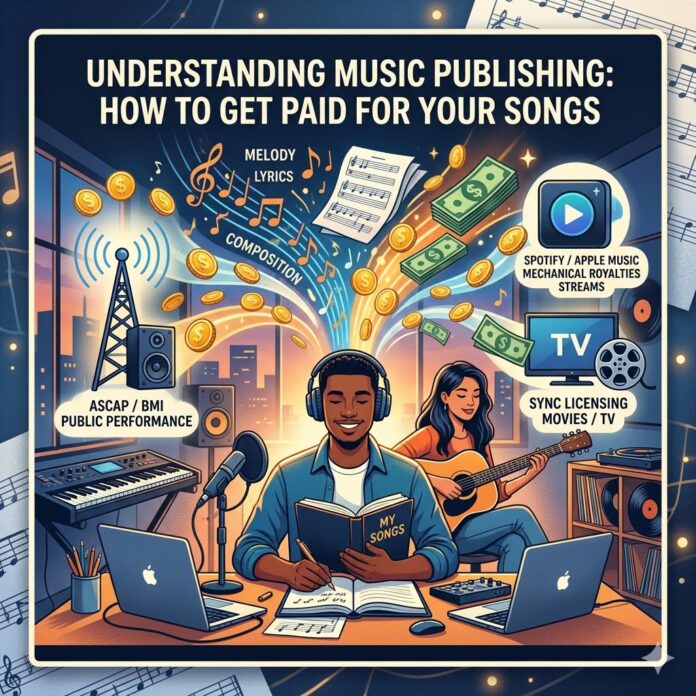
The Songwriter’s Guide to Actually Getting Paid: Music Publishing
You’ve finished the track. The mix is clean, the hooks are sticky, and you just hit “upload” on DistroKid. You’re officially a professional musician, right?
Well, sort of. While getting your music onto Spotify is a huge milestone, there is a massive difference between distribution and publishing. If you aren’t careful, you could be leaving half of your money on the table—literally.
In the music business, every song is actually two separate assets: the Master (the recording itself) and the Composition (the lyrics and melody you wrote). Publishing is all about making sure you get paid for that second part.
1. The Two Halves of the Pie
Here’s the first thing you need to know: every song’s ownership is split 50/50.
-
The Writer’s Share (50%): This is yours because you wrote the song. Even if you sign a massive deal, this half usually stays tied to you.
-
The Publisher’s Share (50%): This is the “business” side. If you haven’t signed with a publishing company, congratulations—you are your own publisher. That means it’s your job to go out and collect this half of the money.
2. Where the Money Is Hiding
There are three main “buckets” where your publishing royalties live. If you aren’t registered with the right organizations, this money sits in a “black box” until it eventually expires and goes to the major labels.
Mechanical Royalties
Every time your song is “reproduced”—which in 2026 mostly means streaming—you earn a mechanical royalty. Spotify doesn’t just pay you for the play; they owe you for the song being played.
-
Who pays this? In the US, it’s the Mechanical Licensing Collective (The MLC).
Performance Royalties
These are generated whenever your music is played in public. Think radio, TV, bars, festivals, and even your own live gigs. Even a stream counts as a “public performance” in the eyes of the law.
-
Who pays this? Performance Rights Organizations (PROs) like ASCAP or BMI.
Sync Licensing
This is the “jackpot” for many indie artists. It’s when a music supervisor wants to put your song in a Netflix show, a movie, or a commercial. They pay a “sync fee” to use your composition.
-
Who pays this? Usually negotiated directly with you or a sync agent.
3. Your To-Do List (Don’t Skip This)
If you want to make sure your bank account actually reflects your hard work, you need to check these boxes:
| Task | Why it Matters |
| Join a PRO (ASCAP/BMI) | They are the only ones who can collect your performance money. |
| Register with The MLC | This is the only way to get your US digital mechanical royalties. |
| Get a Publishing Admin | Services like Songtrust help collect your money from overseas so you don’t have to call 50 different countries. |
| Sign Split Sheets | If you wrote the song with friends, get it in writing now who owns what percentage. |
The “Distributor” Trap
The biggest mistake indie artists make is assuming their distributor (DistroKid, CD Baby, etc.) handles all of this. They don’t. Most distributors only collect your “Master” royalties. If you aren’t registered for publishing separately, you’re only getting half the story.
Bottom Line
Music publishing sounds like a headache, but it’s just about protecting your intellectual property. Treat your songs like the assets they are, and you’ll be set up for a much longer career.


















 🔥 Limited Time: Get 55% OFF All Plans - Ends in: