


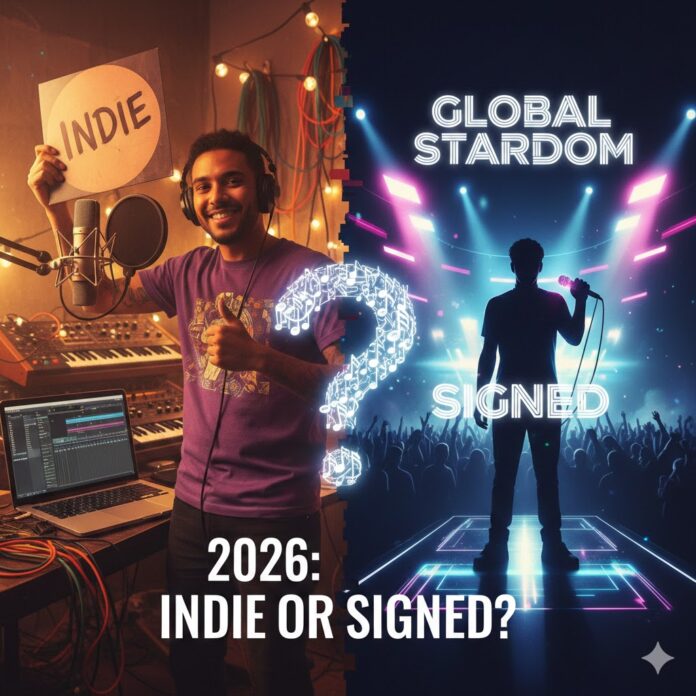
The industry has flipped. It’s no longer about a suit in an office “discovering” you; it’s about you building a fire so big they can see the smoke from across the city.
Here’s the breakdown of the Indie vs. Signed debate as it actually stands today.
1. The DIY Route: You’re the CEO Now
Going indie in 2026 isn’t just about being “punk rock”—it’s a business strategy. With indie artists now capturing nearly half of the global market, the “label-less” path is where the real money (and freedom) lives.
Why it wins:
-
Ownership is everything: When you own your masters, you own the “real estate” of your career. If a Netflix show wants your song for a scene, you say yes, you sign the paper, and you keep the entire check.
-
No “Middleman” Tax: If you have a loyal fanbase that buys your merch and streams your tracks, you keep the lion’s share. You aren’t paying back a $200k loan (advance) at a 15% royalty rate before you see a dime.
-
Authenticity stays intact: You don’t have a marketing department telling you to change your hair or write “more like [insert trending artist].”
The Reality Check: You are also the CFO, the social media manager, and the booking agent. If you hate spreadsheets and hate filming 10 TikToks a week, the indie life might feel like a cage of a different kind.
2. The Label Route: The Rocket Fuel
Labels aren’t the villains they used to be, but they aren’t charities either. In 2026, a label is basically a high-end venture capital firm for your art.
Why you’d actually want to sign:
-
The “Ceiling” Problem: Most indie artists hit a wall where they just can’t get on global radio or land a Coachella main stage without “the machine.” Labels have the relationships that take years to build.
-
The War Chest: Breaking a hit globally costs a fortune. Labels can dump seven figures into influencer campaigns and international PR that most of us simply don’t have in our savings accounts.
-
Focus: Some people just want to write songs. A label takes the “business” off your plate so you can stay in the studio.
3. The 2026 Middle Ground: “Lease” Your Music
The coolest thing about the current market is the Hybrid Deal.
You don’t have to sell your soul anymore. Many artists are now signing “distribution-plus” deals. You keep your rights, but you pay a label or a firm a percentage to handle the marketing for one specific album. It’s the best of both worlds: you keep the house, but you hire a world-class team to renovate it.
The Verdict: Do you need a label?
No. You don’t need a label to be a professional musician. If you can move 500 tickets in a few different cities and have a dedicated Discord or email list, you’re already “making it.”
However… if your dream is to be a household name—the kind of artist whose face is on a billboard in Times Square—you’ll likely eventually need the infrastructure of a label.
The Golden Rule: Don’t look for a label until you’ve built something so successful that you actually have the power to say “no” to a bad deal.



















 🔥 Limited Time: Get 55% OFF All Plans - Ends in: