


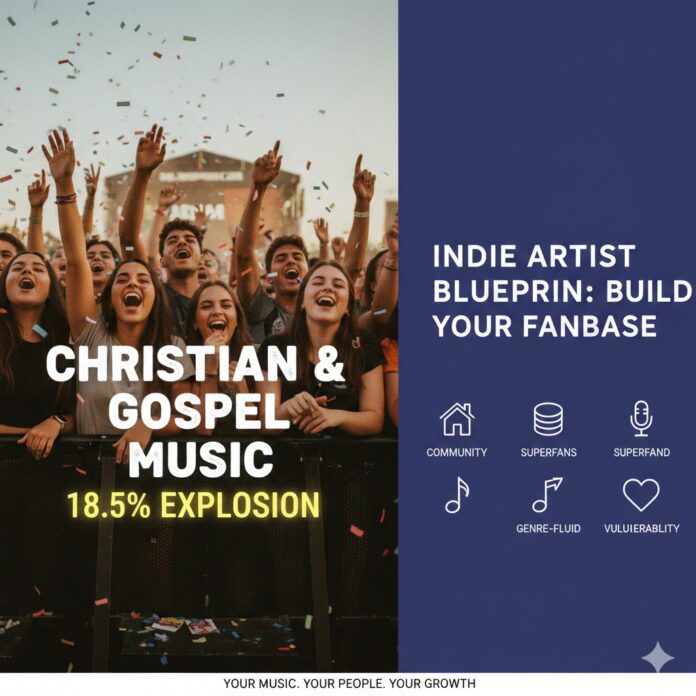
It’s easy to look at an 18.5% growth stat and think, “That’s just corporate numbers.” But behind that massive spike in Christian and Gospel music is a blueprint that any indie artist—regardless of their genre or beliefs—can actually use to quit shouting into the void of the Instagram algorithm.
The music industry as a whole is slowing down, yet this genre is exploding. Why? Because they’ve stopped acting like content creators and started acting like community leaders.
Here is the “human” breakdown of what’s actually happening and how you can steal their moves.
1. Stop Chasing “Reach” and Start Building a “Home”
The biggest mistake indie artists make is treating followers like a billboard. You post a clip, hope people see it, and move on.
Christian and Gospel artists like Forrest Frank or Elevation Worship do the opposite. They treat their digital space like a living room. Their fans don’t just “consume” the music; they talk to each other about how the music helped them through a bad week.
-
The Reality Check: A thousand followers who talk to each other are worth more than ten thousand who just “like” your post and scroll past.
-
Try This: Next time you go Live, don’t just play your songs. Ask a specific question. Facilitate a conversation. Give people a reason to stay that has nothing to do with your Spotify link.
2. The Power of “Rough Around the Edges”
Mainstream pop is obsessed with being perfect. But the Luminate data shows that Gen Z and Millennials are flocking to Gospel music because it feels real. It’s often recorded live, it’s raw, and it’s deeply personal.
In a world of AI-generated everything, humans are craving the “glitches.”
-
The Lesson: Your “imperfections” are actually your USP (Unique Selling Proposition).
-
The Action: Stop over-editing your TikToks. Post the voice memo. Share the lyric that you’re actually embarrassed by. People don’t fall in love with polished products; they fall in love with people.
3. “Genre-Fluid” is the New Standard
One reason for the 18.5% jump is that the genre stopped sounding like “church music.” It started sounding like Lo-fi, Afrobeats, and Indie-pop.
Artists didn’t wait for the industry to give them a category; they just blended what they loved.
| If you like… | Check out… | Why it worked |
| Lo-Fi / Chill Beats | Forrest Frank | He took a “vibe” and added a specific message. |
| High-Energy Pop | KB | He used world-class production values to reach secular fans. |
-
The Action: Look at your “Fans Also Listen To” section. Don’t be afraid to collaborate with a producer from a totally different world. Cross-pollination is the fastest way to find a “ready-made” audience.
4. Solve a Problem for Your Listener
Most indie artists write music about themselves. That’s fine for a diary, but successful genres write music for the listener.
Gospel music is booming because it’s “utilitarian.” People listen to it to feel better, to find hope, or to get through a workout. It serves a function in their daily life.
-
The Shift: Ask yourself: “What does my music do for the person listening?” Does it help them vent? Does it help them focus?
-
The Result: When your music becomes a tool for someone’s mental health or daily routine, they don’t just listen once—they put it on a permanent loop.
The Big Takeaway
The “explosion” isn’t about the music being better than it was five years ago. It’s about the fact that these artists have stopped trying to be “stars” and started trying to be useful.
Growth happens when you stop looking for fans and start looking for your people.



















 🔥 Limited Time: Get 55% OFF All Plans - Ends in: