


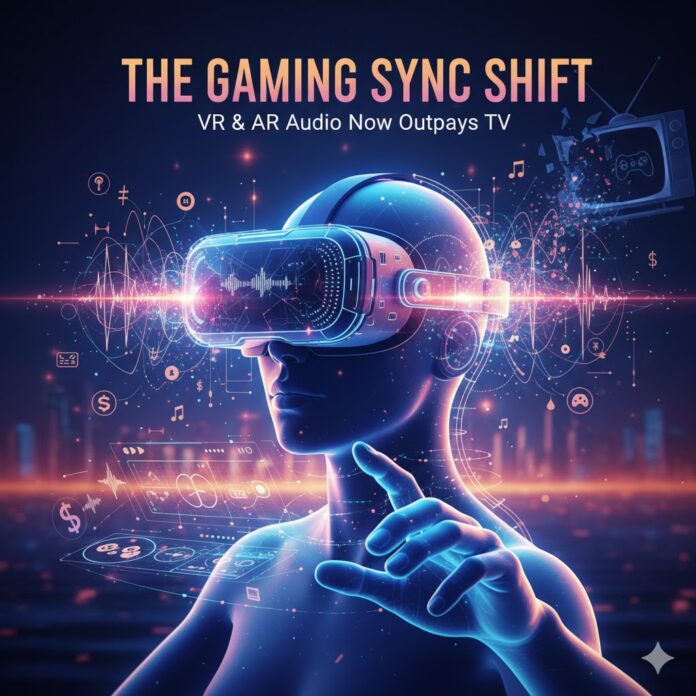
Beyond the “Needle Drop”: Why VR and AR are Outpacing TV in the Sync Race
For a long time, the music industry viewed the “TV sync” as the ultimate prize. Getting your track behind a pivotal scene in a prestige drama or a flashy 30-second Super Bowl spot meant two things: a fat paycheck and a massive spike in Shazams.
But if you’ve been paying attention to licensing trends lately, there’s a new heavy hitter in the room. We’re witnessing a massive “Gaming Sync Shift.” Today, immersive VR (Virtual Reality) and AR (Augmented Reality) apps are starting to command higher fees than traditional broadcast placements. But why? It’s not just because tech companies have deep pockets—it’s because the value of the music itself has fundamentally changed.
The End of “Passive” Background Music
The biggest knock against traditional TV is that it’s a one-way street. You sit on the couch, the music plays * at* you, and if you’re scrolling on your phone, you might miss it entirely.
In a VR environment, you aren’t just a spectator; you’re the protagonist. When a song kicks in during a high-stakes moment in a headset, it’s not “background music”—it’s your heartbeat. That psychological shift from passive listening to active participation creates a brand of emotional “stickiness” that TV simply can’t compete with.
It’s Not Just a Song—It’s an Environment
In the world of spatial computing, we’ve moved past the standard stereo file. We’re talking about deeply integrated, interactive audio.
When a developer licenses a track for a VR world, they aren’t just slapping a .wav file onto a timeline. They’re weaving it into a 3D space. As you walk toward a virtual club, the bass thumps through your haptic controllers; as you turn your head, the vocals shift in your ears.
This level of technical complexity—using stems to create a living, breathing soundscape—requires a different kind of licensing agreement. Because the music is essential to the “physics” of the app, developers are willing to pay a premium for it. It’s no longer a “nice-to-have” vibe; it’s a core mechanic of the user experience.
The Data Doesn’t Lie
Let’s be honest: TV ratings are often just educated guesses. But in a VR or AR app? Every move is tracked.
Developers can see exactly how long a player stayed in a specific zone listening to a track, or how many times they triggered a musical event. For labels and artists, this granular data is gold. It turns a “sync” into a measurable marketing campaign. When you can prove that 500,000 players spent an average of six minutes engaging directly with a specific song, the price tag for that license naturally goes up.
The Long Tail: Beyond the Episode
A TV show has a premiere, a few weeks of buzz, and then it joins the “streaming library” abyss. A well-integrated song in a popular VR game or a social AR filter has a persistent life.
Whether it’s a virtual concert in Fortnite or a custom level in Beat Saber, these placements offer recurring engagement. They become “hangout spots” for digital communities. We’re seeing a shift toward hybrid deals where the initial sync fee is just the beginning—performance royalties, virtual merch, and in-app purchases are turning these placements into long-term revenue streams.
The Bottom Line
The “Gaming Sync Shift” is proof that the industry is finally putting a dollar value on presence.
As we move toward a world where AR glasses are as common as smartphones, the demand for music that can “interact” with the real world is going to explode. The artists and rights holders who win won’t just be the ones with the best songs—they’ll be the ones who understand how to make those songs live, breathe, and react within a digital space.
The screen is getting smaller, but the soundscape is getting a whole lot bigger.

















 🔥 Limited Time: Get 55% OFF All Plans - Ends in: