


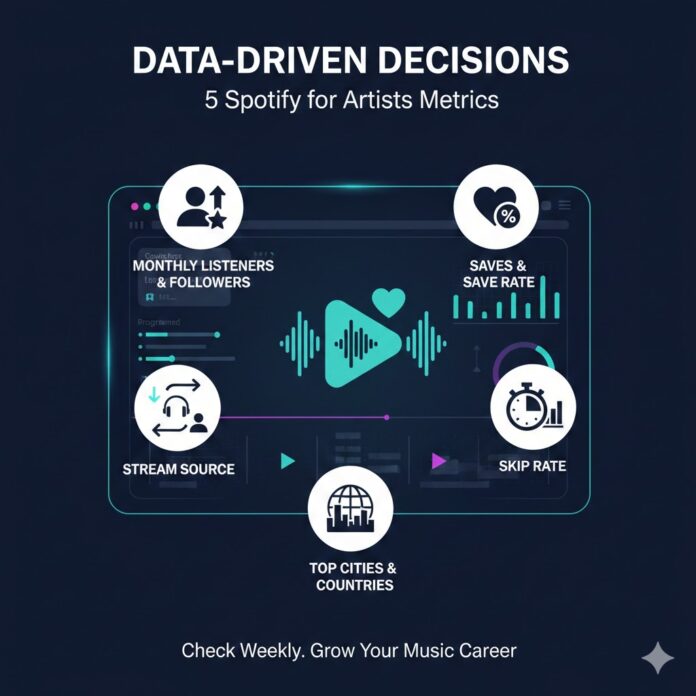
🎧 Data-Driven Decisions: 5 Spotify for Artists Metrics You Should Check Every Week
Are you treating your Spotify for Artists dashboard like a glorified stream counter? If so, you’re leaving money and growth on the table.
In the modern music industry, your success hinges not just on making great music, but on understanding who is listening, how they are discovering you, and why they stick around. The key to unlocking sustainable growth is making data-driven decisions, and the best place to start is with a weekly check-in on the most actionable metrics.
Stop staring at vanity metrics and focus on the signals that truly indicate fan conversion and algorithmic favor. Here are the 5 essential Spotify for Artists metrics you must check every week.
1. Monthly Listeners (ML) vs. Followers
While Monthly Listeners (ML) gives you a snapshot of your audience size, tracking its trend alongside your Follower Count is crucial for long-term health.
| Metric | What it Tells You | Why Check Weekly? |
| Monthly Listeners | Your current audience reach (unique users in the last 28 days). | Indicates the volume of people your music is hitting, especially after promo pushes or playlist adds. |
| Followers | The size of your dedicated fan base. | Followers receive a notification (via Release Radar) for new music, making them a high-value audience for guaranteed initial streams. |
The Data-Driven Action:
-
Rapid ML spike with minimal Follower growth? Your discovery is working (e.g., from an editorial playlist), but you need to optimize your calls-to-action (CTAs) to convert passive listeners into dedicated followers. Update your Artist Pick, bio, and Canvas to ask for the follow.
-
Steady Follower growth? Your marketing efforts are building a reliable base for future releases.
2. Saves and Save Rate
A Save (when a listener adds your track to their library by hitting the heart icon) is one of the most powerful signals you can send to Spotify’s algorithm. It signifies intent and long-term loyalty.
-
How to Calculate Save Rate: $Saves / Total Streams$ (Focus on your most recent release).
The Data-Driven Action:
-
High Save Rate (>2-3% is generally good): Your music is resonating deeply! This track is a strong candidate for continued promotion and may see more algorithmic push (Discover Weekly, Radio).
-
Low Save Rate: The song isn’t connecting on a personal level. Is the intro too long? Does the drop or chorus hit hard enough? Consider creating a more compelling Canvas or running a promotion that explicitly encourages saving. A low save rate suggests you need to re-evaluate the song’s structure or the first 30 seconds.
3. Source of Streams: Listener vs. Programmed
This breakdown, found in the “Audience” tab, reveals how people are finding and listening to your music.
| Source Type | Includes… | What it Means |
| Listener-Driven | Your artist profile, fan-created playlists, listeners’ libraries. | Active Fandom: Listeners intentionally sought out your music. This is the most valuable segment. |
| Programmed | Algorithmic playlists (Discover Weekly, Release Radar), Radio, Autoplay, Editorial Playlists. | Discovery & Exposure: Listeners are passively finding you. This drives reach, but doesn’t guarantee loyalty. |
The Data-Driven Action:
-
Too reliant on Programmed? You’re vulnerable to the whims of the algorithm. Use the streams from these sources to drive Listener-Driven activity. For example, run a social media ad campaign targeting listeners who recently streamed from a specific Editorial Playlist to encourage a Save/Follow.
-
Spike in Listener-Driven streams? Pinpoint the source (e.g., a massive fan playlist). Engage with the curator!
4. Skip Rate (Per Track)
In the “Music” tab, checking the detailed statistics for your tracks, especially new releases, will reveal the Skip Rate. A high skip rate, particularly within the first 30 seconds, is a major red flag. Spotify only counts a stream if it plays for over 30 seconds.
The Data-Driven Action:
-
High Skip Rate on a new single? Your hook is too late. The industry standard for an engaging track is to deliver the main musical idea, or a compelling lead-in, within the first few seconds. This data suggests you need to tighten the arrangement for future releases or create a short video ad that showcases the track’s most exciting part right away.
-
Low Skip Rate, but low Streams-Per-Listener? The song keeps people engaged, but they aren’t listening to it repeatedly. Focus your next promotional push on encouraging re-plays.
5. Top Cities & Countries
Knowing where your audience is located is vital for your real-world and digital marketing strategy. This demographic data is a goldmine for strategic planning.
The Data-Driven Action:
-
Tour Planning: Prioritize booking shows and tours in your top 3-5 cities. Your guaranteed audience is already there!
-
Targeted Ads: Use your top cities/countries for geo-targeting your social media ads and Marquee campaigns for maximum Return on Investment (ROI).
-
Content Creation: Tailor your social media posts to the time zones of your top cities, ensuring your most dedicated fans see your content when they are online. For example, if London is your top city, schedule posts for the afternoon/evening GMT.
📈 Turn Insight into Action
Your weekly check-in isn’t about bragging rights; it’s about a data-driven feedback loop that refines your music and marketing.
-
If Saves and Follows are high, your music is excellent. Invest more in promotion to increase reach.
-
If Streams and Listeners are high but Saves are low, your marketing (discovery) is working, but your song structure or presentation needs to improve to drive loyalty.
Make this five-metric check a non-negotiable part of your weekly routine, and you’ll stop guessing and start growing your Spotify career with concrete, actionable data.





















 🔥 Limited Time: Get 55% OFF All Plans - Ends in:
  you must check weekly to make data-driven decisions and boost your streams and fan base.)