
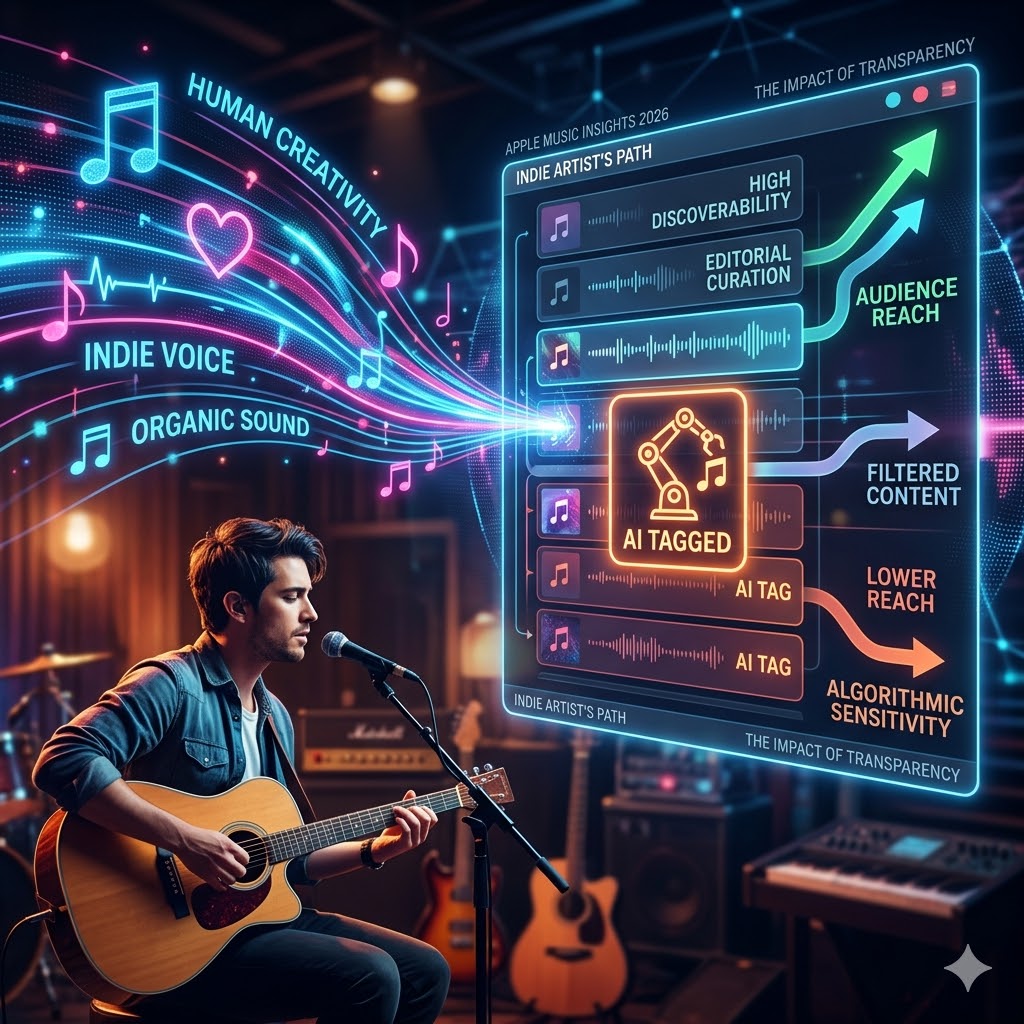
The music industry in 2026 is hitting a massive “reset” button. On March 4, Apple Music officially rolled out its AI Transparency Tags. This isn’t just some boring backend update; it’s a metadata system designed to flag exactly which parts of a song were made by a computer.
If you’re an indie artist, this changes how people find your music. It’s no longer just about the song—it’s about whether you’re being favored by the algorithm or buried under a mountain of “synthetic noise.”
What are Apple Music Transparency Tags, anyway?
Apple is now asking labels and distributors to come clean. If a “material portion” of your release was built with AI, you have to disclose it. Unlike some other platforms that use bots to sniff out AI, Apple is starting with an honesty-based system across four main buckets:
-
The Track: Was the actual audio recording AI-generated?
-
The Songwriting: Did an AI write the lyrics or the melody?
-
The Visuals: Is your album art or motion graphic a midjourney creation?
-
The Video: Was the music video rendered using generative tools?
How This Actually Affects Your Reach
The big question everyone’s asking is: Does a tag help or hurt my numbers? Honestly, it’s a bit of both.
The “Human-First” Bias
Apple has always bragged about being “human-curated.” Early data from this year suggests their recommendation engines—like the Discovery Station—are starting to give a “human-made” preference to non-tagged tracks for those big editorial playlist slots.
The Reality Check: Apple isn’t banning AI music, but tagging acts like a filter. If you’re competing for a spot on Today’s Acoustic or Pure Pop, curators are naturally leaning toward artists with a real story, not just a prompt.
Fighting the “Sea of Sameness”
Back in 2025, we saw streaming get flooded with over 60,000 AI tracks every single day. For a legitimate indie artist, the enemy isn’t the AI—it’s the sheer volume.
-
Transparency as a Flex: By not having an AI tag, your music basically gets a “Human-Made” badge of honor.
-
The Trust Factor: Recent surveys show nearly half of listeners actually want to filter out AI music. On Apple Music, being “AI-free” is becoming a genuine selling point for genres like folk, jazz, and indie rock.
The “Playlist Playground”
Apple’s new Playlist Playground (iOS 26.4) lets users build playlists with AI prompts. If someone asks for “Lo-fi beats for studying,” the algorithm might toss in tagged AI tracks. But if they ask for “New indie artists with soul,” the algorithm is likely to skip the AI and look for a real pulse.
3 Ways to Protect Your Discoverability
If you want to keep your momentum in 2026, you need to be smart about your metadata:
-
Don’t Over-Tag: Using AI for a quick master or to clean up some background hiss usually doesn’t need a “Track” tag. Save the tags for actual generative work so you don’t accidentally tank your algorithmic reach.
-
Flex Your Credits: In a world of AI, your Credits are your “proof of life.” Name your drummer, your lyricist, and your producer. This helps Apple’s editors verify that there’s a real team behind the music.
-
Check Your Distributor: Make sure your distributor (DistroKid, CD Baby, etc.) is actually sending the right info to Apple. If the platform’s detection catches a synthetic track you didn’t label, you could end up in a “soft ban” situation.
The Bottom Line
Apple’s AI tagging isn’t a death sentence for indie music—it’s a fence. It separates “functional audio” (the background noise) from “artistic expression.” Apple is trying to give human artists a clearer path to the fans who actually want to connect with a person, not a program.





 🔥 Limited Time: Get 55% OFF All Plans - Ends in: