
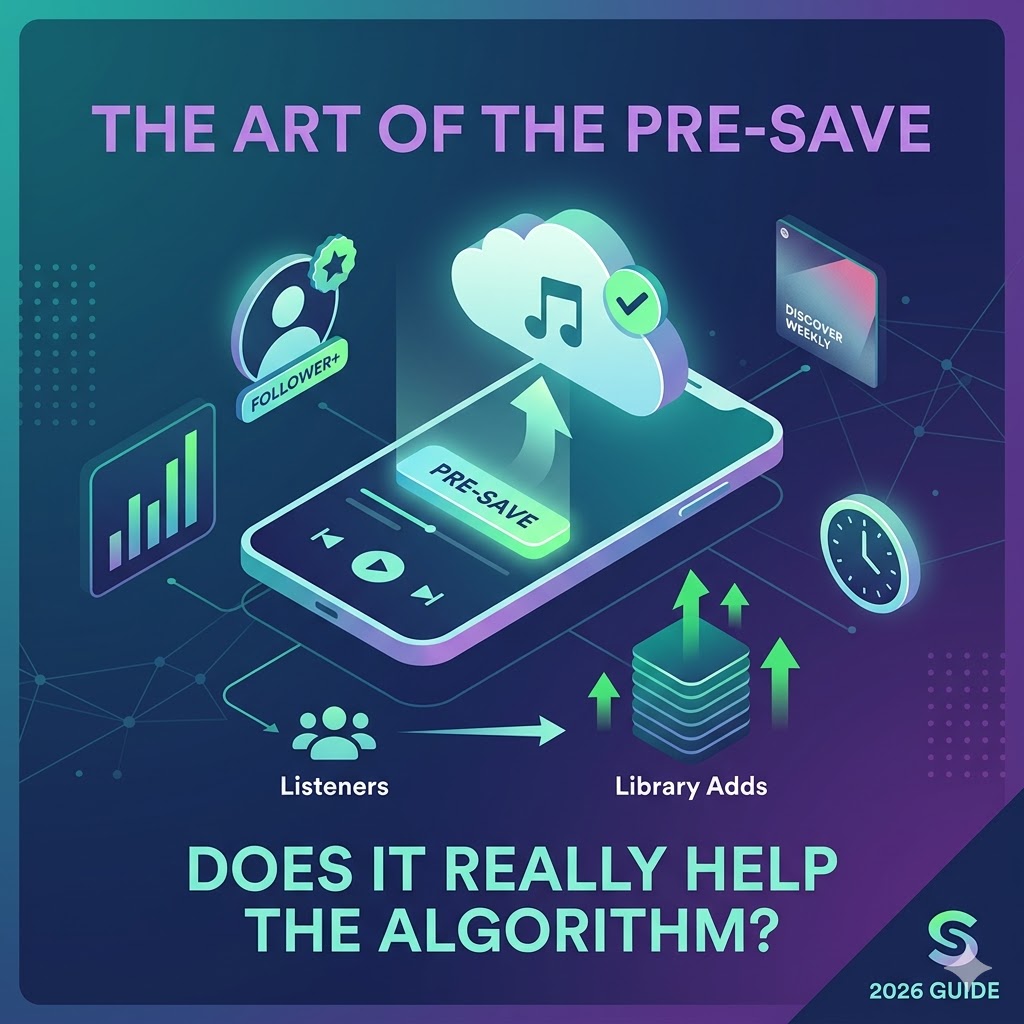
If you’ve spent any time in the independent music scene lately, you’ve probably felt the pressure to spam that link everywhere. But as we move through 2026, a lot of artists are starting to wonder: Is this actually doing anything, or am I just shouting into the void?
The truth is a bit more nuanced than a simple “yes” or “no.” Spotify’s algorithm has grown up. It’s no longer just counting hits; it’s looking for intent. Here is the breakdown of how a pre-save actually talks to the algorithm—and why it might be the secret weapon you’re overlooking.
It’s Not About the Stream; It’s About the “Save”
The biggest misconception is that a pre-save is just a guaranteed stream on release day. While that’s nice, the algorithm actually cares way more about the Library Add.
Think about it: Anyone can accidentally leave a playlist running, but it takes a conscious effort to save a song to a library. In 2026, Spotify weights a “Save” significantly higher than a passive play. When hundreds of fans pre-save your track, you aren’t starting release day at zero. You’re starting with a massive spike of high-intent data that tells Spotify, “Hey, people actually want to keep this song.”
The “Release Radar” Hack
This is the most direct benefit of a pre-save campaign. Most pre-save tools are set up to make the user Follow your artist profile at the same time.
Why does that matter? Because Release Radar is essentially a “Follower Playlist.” By driving pre-saves, you’re essentially force-feeding your new single into the personalized Friday playlists of every single person who clicked that link. It’s the closest thing to a “guaranteed” placement an indie artist can get.
Triggering the “Tipping Point”
Spotify uses something called a Popularity Index. To get onto the “holy grail” playlists like Discover Weekly, your track needs to hit a certain engagement density within its first few weeks.
The 2026 Reality Check: You usually need to see a specific ratio of saves-to-listeners (roughly 1 save for every 6 or 7 listeners) to prove to the algorithm that your music is “sticky.” A solid pre-save campaign gives you that head start before the first 24 hours are even over.
How to Actually Use This (Without Being Annoying)
If you just post a link and say “Please pre-save,” most people will scroll right past. To make this work, you have to give them a reason to care:
-
The “Behind-the-Curtain” Trade: Tell your fans that if they send you a screenshot of their pre-save, you’ll DM them a voice note of how the song started or a clip of a failed take.
-
The 7-Day Window: Don’t start too early. The “hype cycle” for an indie release is short. Start pushing the link about 10 days out so the momentum carries right into release morning.
-
The “Human” Angle: Tell the story behind the song first. If people connect with the story, they’re 10x more likely to click the link to hear how it ends.
The Bottom Line
Pre-saves aren’t magic dust. They won’t make a mediocre song go viral. But in a world where 100,000+ songs are uploaded every single day, they are your way of telling the algorithm: “Wait, don’t ignore this one. People are already waiting for it.” It’s about taking control of your momentum instead of just crossing your fingers and hoping for an editorial miracle.







 🔥 Limited Time: Get 55% OFF All Plans - Ends in: