
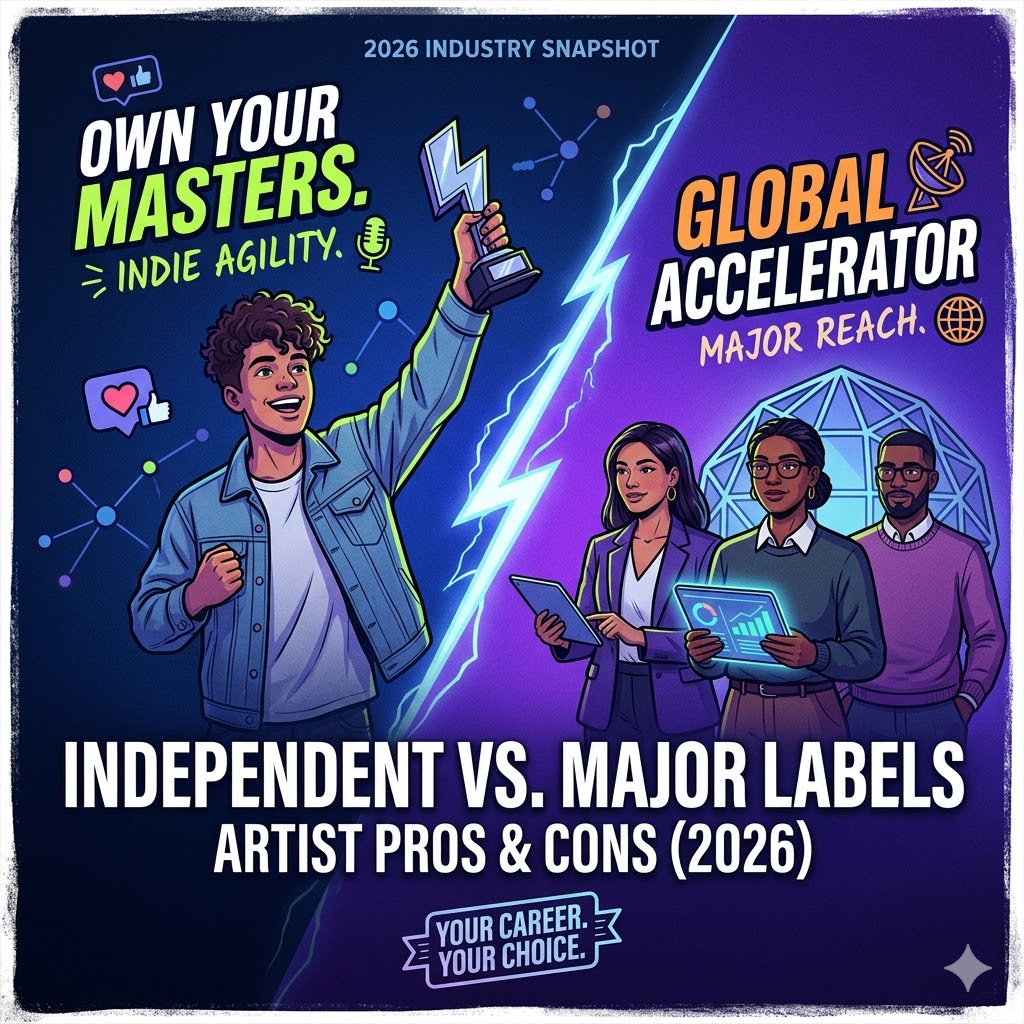
The “Independent vs. Major” debate isn’t the same conversation it was even two years ago. In 2026, the industry has fundamentally restructured, and the old “dream” of getting signed has been replaced by a much more practical question: Who actually owns your career?
If you’re an artist staring down a contract or trying to figure out if you should keep grinding solo, here is the honest, no-filter reality of the landscape right now.
The Indie Reality: You’re the CEO (For Better or Worse)
Being independent in 2026 isn’t just about “doing it yourself”—it’s about owning your equity. With decentralized distribution and AI marketing tools making it easier to find your “1,000 true fans,” the indie path has never been more viable.
The Upside
-
You Own the Masters: This is the big one. In a world where your back catalog can be licensed for everything from AI voice models to high-value sync deals, owning your assets is your retirement plan.
-
Speed to Market: If you write a song on Monday and it starts blowing up on social media Tuesday, you can have it on DSPs by Friday. You don’t need to wait for a marketing department to “green-light” your vision.
-
The Paycheck: You keep nearly 100% of your revenue. You don’t need a multi-platinum hit to make a middle-class living; you just need a loyal community.
The Downside
-
The “Hustle” Burnout: You aren’t just the creative; you’re the bookkeeper, the ad manager, and the content creator. It’s exhausting, and it’s easy for the “business” to swallow the “art.”
-
The Ceiling: You can get 10 million streams on your own, but getting a global radio push or a massive festival slot without a major “machine” behind you is still an uphill battle.
The Major Label Reality: The High-Stakes Accelerator
Major labels (Universal, Sony, Warner) have pivoted. They aren’t talent scouts anymore; they’re venture capitalists. They wait for you to prove you’re a winner, then they dump fuel on the fire.
The Upside
-
Global Muscle: A major label can coordinate a launch in London, Tokyo, and New York simultaneously. Their localized teams can get you into rooms and onto playlists that an indie distributor simply can’t touch.
-
The “War Chest”: Need $250,000 for a cinematic music video or a high-end tour production? They have the cash.
-
Legacy Branding: Rightly or wrongly, being on a major still carries a “prestige” that can open doors with legacy media and high-end brands.
The Downside
-
The Debt: That “advance” is a loan. You won’t see a penny in royalties until you pay back every cent of the label’s spending—including the lunch they bought you and the ads they ran.
-
Loss of Control: Once they’ve invested six figures, they want a say. If the “data” says you should pivot to a trending sound, you might find yourself pressured to abandon your artistic identity for the sake of the algorithm.
The 2026 Verdict: The “Hybrid” Model
The smartest artists this year are choosing a middle ground. They build their brand independently, prove their concept, and then sign Distribution-Only or Short-term Licensing deals.
The golden rule for 2026: Don’t look for a label to save you. Look for a partner to scale what you’ve already built.
Ready to take your music to the next level?
Join thousands of independent artists using ArtistRack to secure professional reviews, global playlisting, and industry-grade PR.
Explore Packages From $28Verified PR • 100% Organic • Trusted Since 2012




 🔥 Limited Time: Get 55% OFF All Plans - Ends in: